Watch Episode Here
Read Episode Description
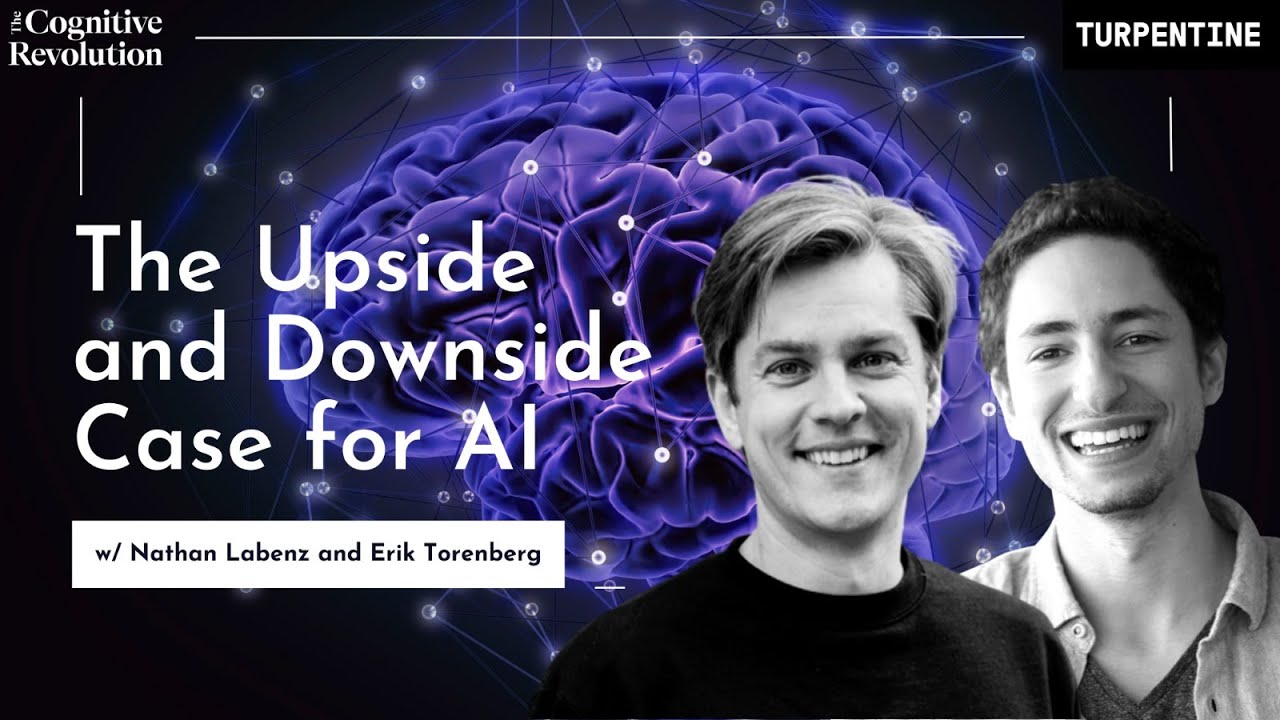
Watch the 2nd episode, where we unpack the future of AI and what you can expect from upcoming guests on The Cognitive Revolution podcast.
Episode Notes
00:00 Coming Up
01:00 The Cognitive Revolution
01:20 Sponsor
01:39 Intro
02:09 Nathan’s path to AI
04:27 Founding Waymark
06:56 The future of AI is just starting
10:00 AI dramatically enhances human capabilities
10:50 Why we started The Cognitive Revolution and what to expect
14:55 Which guests will appear on the show and topics that will be discussed
18:59 Being replaced by an AI host
20:42 Unpacking the future of AI with “no new breakthroughs”
32:21 What’s underhyped and overhyped
43:46 The dangers of AI
44:51 Applying AI safely
52:19 Losing faith in technology
53:38 A new AI ecology
55:14 Facebook, Google and Open AI
58:00 Upside and downside case for AI
58:18 Sam Altman’s case for AI
01:09:25 Starting an AI company
01:18:22 Closing
01:18:46 Sponsor
Resources mentioned in the episode:
Eliezer Yudkowsky: https://intelligence.org/files/AIPosNegFactor.pdf
Mitch Albom’s column: https://www.mitchalbom.com/chatgpt-is-smart-fast-and-easy-all-the-reasons-you-should-be-wary/
Thank you Omneky ( https://www.omneky.com/) for sponsoring The Cognitive Revolution. Omneky is an omnichannel creative generation platform that lets you launch hundreds of thousands of ad iterations that actually work, customized across all platforms, with a click of a button. Omneky combines generative AI and real time advertising data, to generate personalized experiences at scale.
Thank you Graham Bessellieu for editing and production.
Twitter:
@CogRev_Podcast
@eriktorenberg (Erik)
@labenz (Nathan)
Websites:
cognitivervolution.ai
waymark.com
Full Transcript
Transcript
Transcript
Nathan Labenz: (0:00) Now we're seeing how many things are starting to go this way, where people who used to think of themselves as incapable of doing these various tasks, whether it's writing to a certain level or speaking a different language, translating from one language to another, or writing code, all these things that people have found hard are getting dramatically easier. We used to eat grain and turn that into energy in our muscles and move stuff that way. Then we figured out we could dig up this old coal sitting in the ground and harness that to do far more work, and refining that over time changed everything. AI is going to be very similar in that we are going to be able to delegate more and more cognitive work to these new systems. Ultimately, that will reshape not just how we work, but how we live in general. The deeper I go, the more I think about it, the more I firm up my conclusion that, no, this is the real deal. This technology is going to change just about everything. Hello, and welcome to the Cognitive Revolution, where we interview visionary researchers, entrepreneurs, and builders working on the frontier of artificial intelligence. Each week, we'll explore their revolutionary ideas, and together, we'll build a picture of how AI technology will transform work, life, and society in the coming years. I'm Nathan Labenz, joined by my cohost, Erik Torenberg.
Erik Torenberg: (1:23) The Cognitive Revolution podcast is supported by Omneky. Omneky is an omnichannel creative generation platform that lets you launch hundreds of thousands of ad iterations that actually work, customized across all platforms with the click of a button. Omneky combines generative AI and real-time advertising data to generate personalized experiences at scale. Nathan, welcome to our podcast that we're cohosting together, the Cognitive Revolution. It's great to be here. Excited to give people a bit of an introduction about yourself, about why we're starting this podcast, and about the Cognitive Revolution in general. Maybe by way of introduction, can you give a bit of an overview of yourself and how you came to be so obsessed with this topic such that you knew you wanted to go all in on it? When was the moment or series of moments?
Nathan Labenz: (2:12) Yeah. Well, it kind of surprised me, honestly, in the way that it happened because I've been interested in AI for a long time, going back to the 2007 era reading what probably many listeners will know as the Eliezer Yudkowsky sequences, which covered a lot of ground, but included a projection of what AI might mean and how catastrophically wrong it could go for humanity. Of course, that was at the time pretty influential actually and got a lot of people interested in AI safety. It was also widely derided and dismissed as pure fantasy. I was always kind of in the in-between space where it seemed to me his arguments were extremely compelling, but obviously also highly speculative at the same time. So I kind of felt like, in the same way that an asteroid once came and took out the dinosaurs, and it would be really bad if that happened to us. As a result, it seems like it makes a lot of sense for people, for at least some people, not everybody, to be obsessed with looking for asteroids. The great thing about modern civilization is we have division of labor and specialization, and it sure made sense to me that we should have a program looking out at the skies and trying to identify asteroids and make sure that none comes and takes us out like what took out the dinosaurs. Recently, we actually did send a space mission out and deflect an asteroid just to demonstrate to ourselves that we could. I thought about AI for a long time the same way. It sounded to me pretty unlikely, but serious enough that we should take it seriously. That was about as far as it went because I wasn't the one to specialize in the AI safety work. The work as it was conceived of at the time was very technical, very mathy, and I flatter myself to be a pretty smart person, but I was pretty clear on my limitations on the math side, and I was not going to lock myself in the basement for a few years and come out with the provably safe AI theorem that makes everything okay. So I kind of just supported those people that were willing to take on that challenge and otherwise just kind of continued to pay attention to it. That went on for years. In the meantime, I've been an entrepreneur. I started a company called Waymark. Waymark has been historically a DIY video creation platform, something that is designed to be extremely accessible. We make it available through the browser. I have a whole riff that I talk about the three waves of creative: creative one, creative two, creative three. Waymark started as a creative two company, which is to say there's obviously I think of Adobe as kind of being creative one. Power tools for power users, take years to master. Creative two, the kind of thing Waymark was building, highly accessible browser-based tools anyone should be able to figure it out. We worked really hard on that for a number of years. We made it a nice tool, very polished, very intuitive for people. We got to a point where when we would sit down and talk to users and say, what do you think about this product? Is there anything we could do to make it easier? Is there anything we could do to help you use it more? A lot of times they would say to us, it is easy. We used to say, if you can fill out a form on the web, you can make a video on Waymark. People would say, well, yeah, that's true. It really is that easy, but I still don't really know what to say. I don't really have any ideas for what kind of content to make. It turned out that as accessible as we made the tool, that was kind of the main blocker. So we realized that our tool was easy to use. A word processor is easy to use. Anyone can do it. We all know how to type, but that doesn't mean it's easy to write. As simple as we made the tools, people still were having a hard time getting over the barrier and creating video content on our platform. We honestly didn't really know what to do about that from a UI standpoint. But right around the time we were hitting the limits of what we could accomplish with continued UI refinement, things like GPT-3 started to come out and opened up a whole new set of opportunities for how to improve our product. So my AI interest has gone back a long time, but my modern AI obsession really started with this opportunity that we saw at Waymark to say, maybe we can help people with ideas, or maybe they can have a very simple kernel of an idea, and we can help them turn that into fully fleshed out content. I went down that rabbit hole and learned more and more. One of the big things that I've realized is that there is tremendous progress happening within AI across a whole bunch of different modalities at the same time. Text generation, large language models probably get the most attention today, and I think deservedly so. They're super important. I think of them almost as the executive function of the AI future that I think is just starting to take shape. Image creation is also really interesting, especially for us because we're making video content. It's sight, sound, and motion. So you need the script, but you also need the visuals to go with it. So the image creation, the art creation is also super interesting. I just kind of went deeper and deeper and deeper, initially out of pure entrepreneurship motivations, and developed these mantras like AI beats UI. At one point, was even AI or die. I was totally convinced that we either had to catch this new wave, and I started calling that creative three, which is instead of just accessible tools, it's tools that actually help you do the work. For a while, I was at the time the CEO of the company. I founded the company and was the CEO for a long time. But I decided that it was really such a big shift that it was time to pull the emergency brake on the company. I told everybody on the team, even my board, canceled board meetings. I was like, we're not going to do anything else until we wrap our heads around this new AI opportunity and feel like we're starting to pick up some momentum riding this new wave. So that went on for six months. During that time, I basically neglected everything else and did nothing but AI work and tried to get the team, again, catching the new wave. That started to work. But also after a while, as you would well understand, you can only neglect the practical side of running a company for so long. Things started to kind of pile up and demand attention. So eventually, I was kind of faced with a choice. Do I want to try to put down some of this AI work and find somebody who can lead that at our company? What I ended up deciding to do, and I was fortunate to have the right teammate who could take on the CEO role, was promote a longtime friend and teammate who had been our COO and our product lead. He was the perfect person to step into the CEO spot. That allowed me to just go full time deeper and deeper down the AI rabbit hole. I just continue to learn, and I find the topic so fascinating because it is both technically deep, and you have a hard time getting to the bottom of it. Certainly, I don't feel like I've gotten to the bottom of it. It's also philosophically really interesting. What are these things? How should we think about them? How should we relate to them? It's also just practically really cool and useful. One of the reasons I was interested in starting a company like Waymark and building that product is I am not a visual artist, and I needed a tool like that that is so simple to help me create content. So now to see how many things are starting to go this way where people who used to think of themselves as incapable of doing these various tasks, whether it's writing to a certain level or speaking a different language, translating from one language to another, or writing code. All these things that people have found hard are getting dramatically easier. That's changed the way I work. It's changed my daily workflow. I think what I have experienced is really just a preview of what's to come for broader society. So there's a lot to unpack in the AI space, and I'm looking forward to doing that with you.
Erik Torenberg: (10:52) It's a perfect segue into the Cognitive Revolution and what we're doing here. So talk a little bit behind the inspiration for the name and the ideas that underlie it. We were thinking of a good name for the podcast, and you had this idea of the Cognitive Revolution. Talk a little bit about that and what are some of the areas you were hoping to do deep dives on in this podcast?
Nathan Labenz: (11:15) There's a lot of hyperbole in the world today, and every new technology comes with a hype cycle. One of the things I've really challenged myself to think hard about is: is this really going to be a transformative technology? Or is there still some possibility that this will all peter out and we'll look back and, when VH1 makes "I Love the 2020s," will there be this sort of AI vignette that was like, "Oh, remember when everybody was excited about that?" I really have challenged myself to think hard about that. The deeper I go, the more I think about it, the more I firm up my conclusion that no, this is the real deal. This technology is going to change just about everything. People are always looking back for a historical analogy. Is this like the rise of computers? Is this like the rise of mobile phones? Or even electricity? I think electricity is maybe the best of those three, but I think the shift is actually even more profound than even people who are paying a lot of attention to AI tend to think. I conceive of this now as really the rise of a new force in the world—a kind of alien intelligence. It is very different from us. I don't think we should think of it as being like us at all, but it is something that I think is really profound. We're finding new ways to solve problems and to process information. I think the right analogies are actually going deeper into history—looking back at the agricultural revolution and even more so, more recently, the industrial revolution. We used to do stuff with muscles, and then we figured out how to do it with machines. We used to power it with calories. We used to eat grain and turn that into energy in our muscles and move stuff that way. And then we figured out we could dig up this coal that was sitting in the ground and harness that to do far more work, and refining that over time changed everything. I think that AI is going to be very similar in that we are going to be able to delegate more and more cognitive work to these new systems. Ultimately, that will reshape not just how we work, but how we live in general, the day-to-day experience of going through society, the way we interact. It's really hard to picture how that shakes out. Even the inventors, I think interestingly, are not necessarily much better positioned to envision that future than the rest of us. If you were to go back and ask James Watt what society was going to look like as he was tinkering with one of his early steam engines, I don't think he would have necessarily had a great sense for where we'd end up. People are very focused on making the thing work that they are making work. But the big picture, the long-term implications of that are not at all clear. So I wouldn't say that I have great clarity on that either, but what I want to do with the show is both. I hope we can understand the details and really push ourselves and help our audience achieve more precise understanding of a lot of the phenomena that we're seeing, but at the same time try to zoom out and understand to the best of our ability what is the overall change that we're starting to witness. For my money, I do think this will be written about in the history books as a pivotal time like those previous revolutions when, ultimately, everything changes. Yeah, that's well put. I mentioned to you offline that one inspiration
Erik Torenberg: (15:03) for the show is Bankless and what they've done in the crypto space, the web3 space—exactly what you've outlined. They both help make sense of what's happening in the here and now, and I've been a loyal listener for a while. But they also zoom out and explain just why this matters on a broader level. Crypto also is touching various elements of society, but then also they host a number of debates and really wrestle with the different opinions in the space and track them as they evolve. So I think that's well put. Flushing out a bit further, what are the kinds of guests? This podcast, like the space itself, is a bit emergent, and so we're coming up with it on the fly a little bit, and we will benefit from audience participation and what our audience would like to see. But maybe just give a little preview of what kinds of guests or what archetypes of guests and what kinds of questions or topics will we want to explore?
Nathan Labenz: (16:01) Yeah. I mean, I think there are a lot of different ways that we can go, and certainly don't think there's going to be any one mold that a guest has to fit into to be really interesting to us. But in general, I think the prototype that I am most interested in is people that I would describe as already living in the future. People that are working and building with the latest tools that have a vision of their own, which may or may not turn out how they have it in mind, but who do have an ambitious vision for what they want to build and how they want to change one corner of the world. I think those people, again, they're so focused in general on what they're building. They might be building a next-generation art tool. We're going to have the founder and CEO of Replika on as well, and she's got a virtual friend product. What does she envision for the future of virtual friends? I really don't know, but I'm extremely interested to find out what she has in mind for us. Because virtual friends—that's a big shift. We've never seen anything like that. We've had our imaginations, but now to have a technology that can flatter you, that can engage with you, that can potentially challenge you, that can potentially deliver cognitive behavioral therapy to you, that can even bring its own imagined problems to you and ask you to be an ear for it—I mean, this is a totally new world. I think this is just going to repeat across so many areas of life, so many areas of work, even science. What are all these people who have these narrow, domain-specific visions trying to create? How do they envision that part of life changing? And then cumulatively across all of those, can we start to piece together a bigger picture view of what life and society are going to look like as all these things start to come online? And it's only going to be one to two years before most of these things are starting to hit the public. This is not like a speculative thing in the sense that we're going to go do deep R&D for a bunch of years and maybe we'll come out with something. That has already been done by the likes of OpenAI and DeepMind and Anthropic and a few others. Google, I should say, also—obviously DeepMind is part of Google, but Google independent of DeepMind also has a lot of great work going on. That deep R&D continues, but enough of it has been done that the tools are now there to productize this core technology in so many different ways that I think we can expect meaningfully new experiences, different kinds of things coming online than we've ever seen before. And as that happens all at once, it's going to change everything. So trying to get ahead of that and form a picture of what life looks like even just two years from now, I think is a big challenge, but that's a big part of the reason, again, that I'm excited to do this show.
Erik Torenberg: (19:01) Totally. What one meta question for the show or plot line will be: at what point do we get replaced as hosts, and does the audience even notice?
Nathan Labenz: (19:11) Yeah. Well, I just saw last night a new text-to-speech engine. This is basically a daily occurrence at this point. Almost never a day goes by where I don't see something of meaningful new interest coming across. Typically, Twitter is where I find that stuff. Certainly not a week goes by without something meaningfully new and different. But last night, it was text-to-speech, a new product that starts at $22 a month and allows you to clone your own voice in just a few minutes. They're very new. They just launched this product. And already, they're starting to see tons of exciting use cases. People are loving it. It's getting rave reviews. But they just posted on Twitter this morning, I believe, that they're also starting to see some abuse. They're seeing people come in with audio they know that's not their own voice. And they have terms on the site that you must be the rightful owner of the audio and have the consent of the original person. But people don't necessarily have to follow those terms, and it's not always easy for them to tell. So they're already, in just a matter of days, confronting how their product is hitting the real world. And there's a lot there to wrestle with. So I do think we'll be able to, probably could piece together within the not-too-distant future some pretty good AI facsimiles of ourselves, and that is going to come with a lot of questions for us and certainly for the public at large. Yeah, it's fascinating. Going to your timeline idea, Flo on the
Erik Torenberg: (20:49) Moment of Zen podcast that we're also re-releasing as part of this podcast said that in the short term, it's overhyped, and in the medium term, it's underhyped. You—we were talking about this offline—your expectations for the future, even assuming no future breakthroughs, are maybe more shocking than people would realize in terms of what to expect. So why don't you paint a little bit of the future in that scenario?
Nathan Labenz: (21:16) Yeah. First of all, the "no major new breakthroughs" concept is probably worth unpacking just a little bit and explaining. A lot of people know this, but not everybody. What's happening right now is that a few core techniques are being shown to work basically on all the problems to which they're being applied. Those techniques are probably familiar at this point—the transformer architecture that came out of Google in 2017. By the way, for practical purposes, if you're new to AI, that means you really only have five years of intellectual history that you need to catch up on. Everything before that, people would say, oh, you need to understand it. I don't know. I think you can really just jump in, rush straight to the front, and try to understand what's happening now. I personally spend a little time going deeper into history, but not that much. So five years of intellectual history—this has all been pretty recent. The transformer architecture is one. Reinforcement learning is another. That actually predates transformers but has continued to be applied to transformers, which has been a really fascinating convergence. In general, a lot of things are converging, because it also takes cloud-scale compute. That's another major factor—just huge compute power. You can't do this on a laptop or even a few laptops. You can't train these models on consumer hardware. Right now, you can't even really run them on laptops, although I think we will soon see more and more models getting small and efficient enough that they can run on local devices. What's kind of amazing is that this is turning out to be an extremely generalizable approach. Transformers are helping people do the text prediction of the sort that we see in ChatGPT. There are image and video creation technologies that, again, just take in very simple text like "I want to see an image of this" and make it for you—that are also transformer-powered. There's also another kind called diffusion models, which are a bit different, but both are working quite well. And they just continue to roll out across all sorts of different modalities. Some of the ones that I think are most interesting and scary are in biology. People probably are aware of AlphaFold from DeepMind, which was the first AI to solve the protein folding problem. That was a decades-long open problem of trying to predict from the code of the DNA, which then gets translated into the protein chain, what is the 3D shape of that protein going to be? We did not have any good ways to do it. We really relied on lab chemistry and a process they call crystallography, where they try to create a little crystal of this protein and then bump x-rays up against it and then interpret that. It could be a whole PhD's worth of work to create one protein structure through this crystallography process. I'm not an expert at it, but the future—we're probably not going to have nearly as many experts in that because now we have these AIs that can do this guessing at literally 10,000 times the speed. It would take somebody five years to do this. Now it's a couple minutes maybe to come up with a pretty high-confidence structure for a protein. That's going to bring about, in and of itself, a whole revolution in biology because we understand so much more than we have in even just the very recent past. I think we'll see applications of this to the metaverse. The biggest problem I have right now when I put on my Oculus—I do it about once a month—is that there's just not that much content in there, not that many worlds to explore that Zuck and team have created. And they're pretty cool. I think the hardware is pretty awesome, but you just kind of get to the end of the world pretty quickly. Meta also released a text-to-4D model, is what they called it. But basically, what that means is dynamic 3D scenes. So you can now say, "I want to see a dog jumping through a hoop," and it will create not just an image, not just a video, a flat video, but actually a fully 3D-rendered scene with a mesh that you can rotate around. You can place the camera anywhere you want it. That means in VR that you could walk around that object and see it from any perspective. And you can even import those because they are defined as 3D meshes. You can import them into any other 3D world. And obviously, Meta has a vision here. They're anticipating a world where in the near future, their users can put on the headset and conjure up whatever they want and modify their environments and kind of create their own adventures and experiences. And I think that might be the thing that actually moves us into the metaverse. You mentioned crypto a little bit. I'm not a big crypto head. I would punt on almost all crypto questions. But one of the things that has always sounded coolest to me, but which hasn't really happened so far from what I understand, is the truly smart contract. And I think, well, why is that? One reason is I think it's pretty hard to code a smart contract. It's been very hard to code any sort of dispute resolution into an algorithm with explicit code. But I suspect that we may also see AI put the "smart" in smart contract. And I think you can envision a world where people enter into agreements which can live on a blockchain and which encode a method for dispute resolution that actually goes to an AI and maybe even allows you to have an AI-powered arbitration. Maybe that's just the first line of defense initially, but if you can reduce the cost of arbitration from many thousands of dollars down to a buck or two as you use an AI that's obviously always available, specially trained for this—you know what model you're getting because you have a hash of it that's verifiable that's on the chain, so you know what you're pointing to—I think that could also really change the dynamic and the relationship between corporations and consumers in many contexts, or even local businesses and consumers. I mean, a lot of times it's not necessarily the big corporation that people have trouble with. It might be the roofer that they hired. So where do you go if you still have a hole in your roof and they've got your money? I think we could see AI-powered arbitration bring the cost of handling those kinds of issues down dramatically and really improve the market at large and bring a lot of that stuff onto the chain where it's been a little bit too difficult to do historically. There's more, like servant robots. I think the technology, the AI, is getting there now to the point where the robots can understand their environment. They can understand commands. We're seeing it in demo stage—"go pick me up that cup off the counter and bring it over here." In the lab at Google, that is now happening from pure natural language instruction through the computer vision, understanding what you want, and executing on it. I think it's likely that we're going to see mass production of those robots and actual deployments to everyday households in the next two years. But in the next five years, I do think that's starting to look pretty likely. Also, personal AIs. You mentioned earlier AIs that could replace us in the podcast. I don't know how that is ultimately going to shape up, but we see so many people right now working on little bots to draft your emails as you, or come up with a reply to your tweet mentions as you. And those are starting to get okay. I personally haven't found them to be quite a replacement level for myself. Maybe that's narcissism. But there's a lot of different roles that such a thing could play, and it doesn't necessarily all have to be about publishing thought leadership content. It could also be about just handling regular mundane business. Like handling the scheduling emails that I type out on my own. I don't need that to be genius content. We just need to identify a few times and move the conversation forward. Or I'm a big fan of what DoNotPay is doing right now in terms of language models that go and talk to, for example, Comcast and try to either renegotiate your bill or get some overage fee from your cell phone carrier eliminated. AIs that kind of represent you, act as you, are your agent—I think will be extremely interesting and ubiquitous before we know it. Energy is another one. Everybody, I think, agrees that if we could have clean energy, that would be awesome. And when I see things like DeepMind's fusion control paper, where they train a reinforcement learning system to control a bazillion knobs, ultimately controlling a bunch of magnets to control the fusion reaction environment in a way that certainly no human could do, or that we're very far from being able to explicitly code those controls—I think, man, maybe AI could even help us solve the energy problem. So, man, I could go on about this forever, but that's a sampling of all the different aspects of life, from energy to medicine to interaction. Then we got Neuralink too that's going to bring brain-reading interfaces. And as Elon Musk put it recently—I recommend Neuralink's recent show-and-tell video for another kind of glimpse into the future—he said, the best way to interpret what's going on in the neural net that is your brain is another neural net. So even understanding our own brains and the activity in them is ultimately now running through AI models. So all these things coming together, and all these things exist. They're not all refined. They're not all productized, and they're not all integrated. But I think that those things are basically inevitable at this point. They will be refined. They will be productized, and they will be integrated and combined in all sorts of ways. And entrepreneurs are going to really get their hands on these and create all new things. The role of the R&D research lab, whether it's a university or a major corporation, and the role of productizing that—those are quite different jobs. The first one is done. The second one is just starting to be done. But it is that second job of kind of refining, productizing, and figuring out how to remix and recombine all these things that will ultimately bring us the form factors that will become ubiquitous in our daily lives going forward.
Erik Torenberg: (32:24) That's a fascinating overview. I'm curious to
Nathan Labenz: (32:27) get
Erik Torenberg: (32:27) into what's underhyped and what's overhyped. Or where do you disagree with the—or what do the naysayers miss, and where do the doomers miss? Or what points do they get right?
Nathan Labenz: (32:40) Yeah, well, I'm both. For starters, I have felt over the last year or two, especially the last year, a really interesting mix of exhilaration, anticipation, and excitement for this technology and what it can mean, what it can allow me personally to do. But also, the opportunity to create radical access to expertise is one of the big things that I'm expecting. So many people around the world really suffer for lack of access to expertise. And I think it's extremely exciting to imagine a world where all of the world's 8 billion people can have access to a good quality frontline doctor, for example, that can help them understand what's going on. There's tremendous potential in that, and I'm super excited about it. At the same time, I do think those who worry about catastrophe are right to worry about catastrophe. I'm pretty reluctant to use analogies because I think it's much better in general to try to understand the thing on its own terms versus trying to shoehorn understanding into analogies. I think they can mislead us pretty easily. But one that I do find useful is the analogy to invasive species. I was inspired on this because I took my kids to the Detroit Nature Center not too long ago. And I realized that most nature centers around the world are pretty much the same. They all have here are the amphibians that are local to our environment, and here are the lizards, the frogs, the bees, the small mammals, and the birds. And you think, well, all around the world, every nature center has those same things. Why is that? And the answer is all of those things were at one time invasive species that colonized the whole world. They all started somewhere, and much like humans, they all colonized the whole world. So there is actually a lot of precedent for some new form that is quite fit and quite adaptable to pop up. And of course, it has to pop up in one place. And if it has sufficient fitness and adaptability, next thing you know, it can be everywhere. That takes a long time when you're humans walking out of Eden and gradually covering the whole world. I think it will happen a lot faster in the context of AI. And I think at the highest level, we're really not ready for that. We have no idea what that is going to look like. So from my standpoint, it's an emotionally interesting mix. And I try to keep both in mind, this exhilaration and excitement for what's to come, but also the recognition that we're not ready and that there are real reasons to be concerned. I mean, you mentioned the naysayers. On that one, it's a little bit tough. I honestly have to work hard to try to understand what people are thinking when they go use ChatGPT and say that it's not interesting to them or it's not impressive or it's boring. So I don't have a ton of confidence in what's going on there. I think one thing that people have consistently failed to do over the last couple years is just understand that whatever they're looking at right now is not likely to be the end state. You've heard these same comments. Well, GPT-2 sucks. The output's not very good. Yeah, kind of cool, but it'll never be useful. GPT-3, well, it's better. It's a lot better, but it still kind of sucks, and you've got to prompt it in these weird ways. Oh, InstructGPT. Well, that's pretty cool, but it still does these things wrong. And now we're on to ChatGPT, and it's like, man, it does a lot of things right. But look, I can still trip it up on this math problem, and no human would make that mistake. So we're not at the end of that journey. So I think that's one thing that people are missing. They're taking these snapshots in time and zeroing in on these limitations and jumping to the conclusion like, well, this will never amount to anything because it couldn't do this. That's very odd to me, but I do think that's a pretty common pattern. I think another thing is implicitly evaluating these AIs on a human standard. And you do see that or hear that notion that a human would never make this mistake. You hear that fairly often. And I think that's true in a lot of cases, but also missing the point. Again, invasive species. I also think about these AIs. I'll try to discipline myself to thinking about them as aliens. I really try to keep in mind that even though this is speaking my language, even
Erik Torenberg: (37:57) though, you
Nathan Labenz: (37:57) It's learned so many human intuitions, but it is an alien beast under the hood. Its cognition shares some important traits with mine. It can do a lot of the same things I can do, and I can do things it can do. So there's a lot of overlap, but there are also very profound differences that run super deep. And as a result, there are different strengths and weaknesses. ChatGPT makes a lot of math mistakes, even simple arithmetic, but it's also really good at coding. Most people can't code. Obviously, some can, most can't. It can do arithmetic by generating the code to do the arithmetic, and then it can use a calculator. That's kind of like, oh, well, it has ways of compensating for its weaknesses. In that case, it's similar to us. Right? We're not great at computation either. We use calculators. So in that sense, there's some similarity as well. But I really think it's important to try to understand these things as much as possible on their own terms. I think these analogies are evocative, hopefully suggestive, hopefully get wheels turning, but shouldn't be taken super literally. Trying to keep in mind that these are alien intelligences that we don't have great intuitions for out of the box, that have very different strengths and weaknesses from us, and that the strengths relative to us are probably more important to understand than the weaknesses in some ways. Right? I mean, if I can do a certain task and it's very trivial and easy to me and an AI can't do that task, well, so what? Right? It was already trivial and easy to me. If it can do things that are well beyond my capabilities, then that's a huge deal because I previously had no way to do those things. So I do think people are missing the point in some cases where they zoom in on, oh, well, I would never make this mistake. It does. Therefore, it's dumb, and I'm smart. But I would really encourage people to look at the reverse and say, what can it do that you can't do, and what would you take away from that? So those are a few big ones. And we talked a little, I mentioned earlier the entrepreneurs thing. I do think we're looking at pretty raw technology right now still. And what has not happened yet, but which will happen, is change in process. You can look back at recent shifts in such major things as how we get around with the rise of Uber, where a new technology paradigm allowed for the rearrangement of that activity and just a fundamentally new structure that created new ways of doing things. Dating is a similar one. I got married too young to ever be on Tinder, but obviously it's very different than it used to be. And the technology, first the technology had to be invented and then people had to figure out how to restructure the human activity to take advantage of that technology for better or worse. I think people are rightfully thinking right now, is that all to the good? I don't know. I've never been on Tinder. But when it comes to AI, it'll be the same. Right? There's going to be a lot of activities that can be pulled apart, atomized in various ways, broken down into subparts, and the parts that are readily delegatable to AIs will be delegated to AIs as soon as people can figure out how to rearrange the work processes to do that. And that process is just getting underway. So I think we really don't know what that's going to look like. That's one of the things that I hope our guests will help us understand and envision in a much more detailed way across a lot of different areas. But I think that is maybe the biggest one that the naysayers are missing where they're like, boy, I'm just talking to this language model, and it can't use the Internet, and it can't do anything. All it can do is generate text. That is the raw technology. Right? That's like the iPhone before there were any apps in the App Store. And all those apps are coming. I think they're going to be a huge, huge deal and certainly have much bigger consequences than the naysayers are imagining. I don't really think the doomers are, they might be overconfident, and obviously, they are confident to varying degrees. I think more often, they're actually pretty intellectually modest. And it's not that they're saying this is definitely going to happen. It's more like, hey. I don't know if this is a 5 percent chance of happening or a 25 percent or whatever. We probably can't get that precise in those numbers. But if you believe it's anywhere in that range, that AI could literally take over the world, then going back to the asteroid metaphor at the top, we really should be paying a lot of attention to that. And it seems like, I agree that the doomers, at least the ones that I know, broadly very much appreciate the upside of the technology. It's not like they're blind to it. They are just choosing to focus their time and attention and their messaging on the risk because they think it is broadly neglected and dismissed, and they think that's wrong. I personally cannot find any flaws in that argument. I would be open to somebody who says, well, I think it's only a 1% chance, and somebody else who says, I think it's a 50% chance. I have pretty radical uncertainty there about just how dangerous these new things will be, but I haven't heard anything that is compelling to me to say that I shouldn't worry about that. And really, it seems to be mostly when people are like, oh, that's silly. I think that's an analogy gone wrong. Right? I think they're making an analogy implicitly to fiction and saying like, well, yeah, you're just being overly influenced by the Terminator or whatever. And by the way, most of these folks hate the Terminator because they've heard that so many times. That is such a farcical vision of what would happen. The reality is not going to be anything like that. But it still could be very hard to control. I think there's a couple different strains of thought on this. On the Moment of Zen podcast, Omnej did, I think, a nice job of articulating the Eliezer Yudkowsky view, but I would say that's probably not the predominant view at this point in the AI safety community. Even Eliezer, I think, has evolved. His original idea that some kind of small kernel of intelligence could go critical, almost like a nuclear criticality chain reaction, exponential explosion type of thing mediated by recursive self-improvement, that's the phrase that people are most probably familiar with, recursive self-improvement. That's a very interesting idea. I don't think that really resembles the AIs that we are seeing today. What we're seeing today in contrast are very broad models. They're not like these tiny little kernels of super hard intelligence. They're instead much broader, softer, less reliable, but still extremely useful intelligence. And we're in the process right now with reinforcement learning of banging them into shape. It's almost like raw metal that needs to be formed. And so through this huge process of collecting more and more feedback, we're gradually identifying the cases where it doesn't do what we want it to do and teaching it to do what we do want it to do. That's a big part of what has gone on to make ChatGPT, you could call it safe. You could call it inoffensive. You could call it woke at times. But there's been a lot of work that's gone into that to try to shape that behavior in an intentional way. And the modern view of the safety risks, at least the ones that I think are most likely to hit us in the not too distant future, are based around that reinforcement learning concept. And specifically, there's just one insight that I think is super profound. It's that humans are fallible. Right? We are not reliable in all sorts of ways. The heuristics and biases literature, the behavioral economics literature, shows lots of little ways that people are reliably or at least predictably irrational and exploitable. And so in the context of training AIs with feedback, the mechanism really is that they are trying to do whatever the human will give them the highest score for having done. That's the core idea. Right? The AI is trying to do whatever will maximize the human feedback score. Given that we are not fully reliable and that we are predictably exploitable, it's not a big leap to think that there are times when the best way to maximize the score is not by being honest. Right? And in fact, by being deceptive or lying. You can think about that in your own personal life. Right? Are there times when you can get through a situation a little bit better and get higher marks and have a more pleasant interaction by being less than fully honest? Yeah. Right? I mean, just a little flattery here or there that maybe you didn't fully mean to give, just one very obvious case. So if the AIs can start to pick that stuff up and they can learn that deception is sometimes a path to higher scores. Right? And then that would imply that they're starting to develop a psychological model of people where they're not just trying to give the raw truth, but they're instead trying to give the version of the truth or just whatever output that will get the highest score from people. Now you've got a really dangerous dynamic on your hands where you don't know when is this thing being honest with me, when is it potentially deceiving me, when is it manipulating me to get a higher score. And of course, you can try to test for that behaviorally in all sorts of ways. And that work is, I think, already underway. Leading companies could do a better job, honestly, of sharing more of what they're doing in the safety realm. Totally makes sense to me that they don't want to share all their trade secrets, but I would like to see a little bit more transparency on what they're doing on the safety side. But I think that process of trying to identify that failure mode of is the AI learning to deceive us. I think that is underway at the biggest companies. It's a tough one, and we don't have great visibility into the internals of what is happening in these models. It's not clear right now that we would be able to identify deceptive behavior if it existed. So, and there's a lot of good stuff happening in the mechanistic interpretability field, which is really trying to solve that black box problem. And that happens in all different kinds of angles and all different kinds of scales. How are AIs solving these various problems? Literally from node to node within the matrix, trying to trace causal paths so that you can really get down to a very granular level and even visualize, this is the mechanism for how it's doing these different things. That work is making a lot of good progress right now, but it kind of feels like there's a little bit of a race between the scaling up of just the raw power of the models and the reinforcement learning. And with that comes this risk of potentially learning to deceive us. And then on the other hand, can we crack these things open and gain a strong enough understanding that we can be confident as to whether or not that is happening? That I think is a super important race. And the model developers are pushing forward. They are pushing their capabilities forward. We're doing this reinforcement learning at greater and greater scale. They are also trying to solve the black box problem internally, and the broader world is trying to solve that black box problem. But right now, I think it's definitely fair to say that those who worry about it are, in my mind, very well justified in doing so.
Erik Torenberg: (51:16) That's a good overview of both the naysayer and doomer perspective. We do hear a lot about the doomer perspective and the different versions of it. We don't hear a lot about the utopia or the opposite of the doomer perspective, and I'm curious if you could outline what that could look like. And then I'm curious if you can respond to the recent critique Thiel made in a couple of his talks where basically, he's painting the overview of the last 10, 15 years, and he says, originally, it was much more idealistic. It was much more, here's what AI is going to bring, and we must, it's our duty to bring it. And he chronicles that movement as evolving into what he calls a big burning man camp. And they got much more scared about it, much more doomerish, much more passive, much more we need to slow down, we need to be careful. And he says that that is a microcosm of what's happened in society in general, and that we've lost faith in technology and are just much more cautious and conservative and less ambitious than we used to be.
Nathan Labenz: (52:22) Yeah, that's interesting because I broadly agree with Thiel's worldview in terms of there's a certain mojo that we've lost. I often cite to people that the Empire State Building was built in like 400 and some days, and the Golden Gate Bridge was like a 3 or 4 year project. These days, the Second Avenue subway line is often cited, and there's the however many million dollar bathroom in San Francisco that may or may not happen, depending on all the veto points that it has to get through. I think that criticism of American society or Western society certainly seems to apply in Europe as well, although they do build subways far more economically than we do. So it's not all bad in Europe. I think that critique is broadly right, but I don't think we should rush to apply that to AI, because the power of this is just totally different. Again, on the AI side, it's a fundamentally new thing. We don't know what we're in for. We don't know what dynamics are going to emerge. I'm kind of expecting a whole new AI-osphere, I might call it. I've been using the term AI ecology lately, increasingly often as well. It's not just that we're going to have one new powerful thing from an OpenAI or a Google that's going to change the world. It's that all this stuff is going to happen at once simultaneously, and we're kind of letting all of this stuff out of the barn right now without really a good sense for how it's going to shake out. In this way, I kind of think Thiel is sort of wrong in that Sam Altman is going pretty fast. I think he's also in some ways showing some admirable restraint. But you can't really look back at the last 5 years and say that they're not moving forward or that they don't believe in technology. So yeah, maybe, I just posted a Twitter thread on Mitch Albom and his column on ChatGPT, which actually I thought was pretty good overall. I was glad to see that because I grew up a huge fan of Mitch Albom and read him in the Detroit Free Press every day, which we got at home as a kid. So it was cool to see that he had a pretty wise take in some ways. Maybe in general, the media is sort of too negative and the culture is maybe too negative. But I don't know. You look at the people who are really doing the work, and I don't feel like that criticism fits them.
Erik Torenberg: (55:16) Yeah. Not Sam, but maybe Facebook or Google or some of these other players that had such a big head start, and yet what happened? Maybe Sam is the exception to the rule at some point.
Nathan Labenz: (55:28) Yeah. We'll see. Google, I mean, certainly Google has become bureaucratic. I've never worked there, but that seems to be, by all accounts, true. It's important to keep in mind also that they had a head start, but going back to 2018, 2019, 2020, 2021 technology, it was not a credible threat to Google. It was not something that was going to substitute for the content you would find via search. It wasn't really capable of answering questions at that high of a level yet. Now we're tipping into a world where it is starting to hit that level. ChatGPT can answer a lot of questions. I do find myself going to AIs for some things that I used to search for. So there is a shift underway, but it's really only been the last few months. And so I think it really depends where you start the clock. And I think it hasn't been that long. It's only been 2 months right now since ChatGPT was first released. Feels like a long time. It is a long time in AI years, but it's not really that long. And they already have a code red at Google, and they do have technology that is roughly on pace with what OpenAI has. So I would personally be pretty surprised if they can't get it together and really get into the game and make an effective launch. I guess we'll see. Is it going to happen in the next 3 months? Maybe, maybe not. I would be pretty surprised if they don't have something very compelling online this year, though. And you just couldn't have done it that much farther in the past than that. So I think that is really, again, one of the big things I keep coming back to always is threshold effects. Things keep going from basically impossible to basically easy. And answering kind of any random user's question about anything is one of those things that is kind of making that flip right now. Let's see how they do. I think you're going to see, obviously we've got to expect that the OpenAI and Microsoft partnership is going to bring something like this to Bing. Nothing is going to motivate Google. That's why Larry and Sergey are coming back, because they see the writing on the wall. Bing's going to maybe even take the lead on them for a minute. We'll see. I think they will act pretty fast in the end.
Erik Torenberg: (58:03) Kind of in summary here or zooming out a bit, you touched on it a little bit, but why don't you summarize your perspective on what is the upside case for AI and what is the downside case and kind of the best arguments for and against both?
Nathan Labenz: (58:18) They're both very extreme. Sam Altman recently gave an interview, and I think he spoke to this pretty well. He said the upside case is almost impossible to imagine, and you start to sound crazy when you talk about it. He did start to sound a little crazy talking about it there for a second. But it's not inconceivable. I think the base upside case, just imagine we can get all the stuff that we have invented working reasonably well and not causing huge problems. I think that could take us pretty far toward a post-scarcity society. When you think about what is scarce today, energy remains scarce. Sam Altman's got a fusion project underway to try to address that as well. Pure intelligence doesn't solve everything on its own. But so much of what people really lack today is expertise. There are so many people talk in medicine, for example, about the gap between the known and the applied known. There is this kind of 20-year, basically a full generation gap most of the time from when things get discovered and proven out to when they're in wide clinical adoption. And that's really just looking at the developed world, at the US. So you've got kind of maybe three tiers of medicine. Obviously, it's a huge oversimplification, but there's what is the frontier today, what is known, what is in regular clinical practice across, say, the US, and then what are people doing that just don't have access to even your kind of mainline medical care. And what's really scarce there is the doctors' brains. It's the ability to interact with the patient, understand what's going on, and figure it out and make recommendations. Then you have also some other key things. You need to have drugs when you need them. You need to have machines in some cases to do stuff. But still, so much is alleviated just by giving people access to quality expertise. And that happens in so many different domains. I just think about all the people that are really disadvantaged in that respect. This is the biggest upside moment for them ever, really. I don't think there's anything close, any second to what this would be. And again, I'm still talking mostly base case here. I don't think this would require any new breakthroughs to get to the point where you could have a readily available AI doctor that could serve anyone around the world in their native language at basically human level, potentially even faster than human level. Certainly more availability. Certainly better price point. And that's a total game changer right off the bat. You can kind of play that out vertical after vertical, and it starts to get pretty amazingly exciting. People don't have access to legal representation. I was just talking to somebody here who's working in a prison reform movement and has a nonprofit here in Michigan. And she was saying she's starting to use ChatGPT to write letters to the parole board, to the judge. A lot of people that she works with, obviously, they couldn't afford a lawyer, then they get a public defendant. She works with people right now, there's somebody who has been in Rikers for 3 years and hasn't seen a trial. Just got assigned a public defender, and the public defender hasn't even seen her because he's too busy and backed up on his cases. So again, I just think for those of us who have the means and can afford the cost, it's still potentially awesome. But for those that are just doing without, it is a total game changer. I think it will be a radically egalitarian force in many respects. On the consumer side, I really think the consumer surplus is going to be tremendous. How exactly that plays out on the ownership side, we'll hopefully piece that together a little bit. Nobody has a crystal ball on that one right now. We'll piece that together over the course of many episodes, but definitely expect that the consumer surplus is going to be extremely high. So again, that's kind of base case. You start to think about, geez, well, what if Google just announced recently, for example, that a million researchers globally have now tapped into the AlphaFold protein structure database. And that's something that's just been created and released. AlphaFold, I think, is about 2 years old. The whole universe of proteins being published and available is maybe a year, probably a little less than a year. And already, that has scaled to a million researchers. So hard to say how that's going to play out, but you really had a very hard time figuring out what the structure of a protein was going to be until this technology came online. And the fact that a million researchers are using it demonstrates just how big of a difference it is in their field. So it seems like we're probably headed for a biological revolution as well. And that can be drugs, much more simulation, much more stuff that's done in advance of even getting to clinical trials, the efficiency, the cycle time should be, I think, dramatically sped up. Just the pace of discovery should be dramatically advanced there. And then energy too. DeepMind also had a paper about using AI to control a fusion system. And the engineering, obviously, of a fusion reactor is incredibly complicated. They use magnetic coils essentially to control the reactor space. And you've got a ton of coils, and it's a hard control problem. So in a way, it's very similar to a lot of the other stuff that they've done in terms of teaching AIs to play video games. It's kind of like you have just one big controller with a ton of buttons, and you've got to learn how to mash them to maximize your score. So in that sense, it's not even necessarily, I mean, they would probably say, well, there was a lot more to it that went into it. But you can see the leap from playing a video game well to controlling this fusion reactor device. And if something like that works, again, if energy gets 90% cheaper, a lot of our problems go away. Not to mention climate change also gets cleaned up by that. Those are kind of mid-tier speculations in my mind. I don't think we can say for sure that that stuff is going to happen, but it seems increasingly likely. And then you get into the Sam Altman realm of crazy, and he's talking about, what happens when we can make as much progress in science in general in one year as we have in all of human history. And at that point, I think, you're basically just talking about the singularity, and all bets are off. I don't really know what to say about that. But it could happen. I think that's also maybe before then, but certainly at that point too, then you do have to start to take the downside case very seriously. Which is just loss of control. Gradual base downside case, I would say, is we become very reliant on these systems. And we're already kind of there with the electrical grid. I always kind of feel like I'm taking crazy pills when I think about the possibility of a big solar flare coming and knocking out the electrical grid. We could all be standing here, as I understand it, and I don't know that solar flares are that well understood, but there was a big one in the mid-1800s. And it didn't damage the electrical grid because there was no electrical grid at the time. People all survived. But today, if it took out the electrical grid, we'd have a big problem on our hands. And I don't know how well we'd be able to rebound from something like that. And we're not talking, that's 150 years ago. We're not talking about the dinosaurs' timescale. We're talking about Civil War timescale. So imagine that just 10x compounded if we become as dependent on AI that's running on electricity as we are on the electricity itself and kind of get to a point where people don't really know how to do a lot of things anymore because it's all kind of handled by systems that talk to other systems, and then all of a sudden, that's disrupted. I think that could be a real risk factor that could put us in a pretty dark place. And that's without anything super exotic happening, like AI becoming power seeking or becoming deceptive or developing goals of their own, all of which used to be very much viewed as speculative or fringy sort of ideas. But no less than Greg Brockman just tweeted the other day that they need to be looking out for things like power-seeking behavior as they continue to build up the power and also the reinforcement learning cycles on their most advanced systems. So I thought that was actually great to hear because historically, I hadn't had the sense that the people that were most enthused about building these things were also equally concerned or as concerned as they should be about the safety and downside risk side. But that was really reassuring.
Erik Torenberg: (1:08:35) And then
Nathan Labenz: (1:08:36) Sam Altman also recently said in that same interview that the downside case, he put it very simply, is lights out for all of us. So it doesn't get much more stark than that. And yeah, I think the one thing we can say pretty safely at this point is we will not stay in the middle. We're not going to stay where we are. There is an incredible, irresistible upside that's just too tantalizing that there's no way we will not pursue it. And the cat is well out of the bag, I would say, at this point. But it definitely does come with a very real risk. And it's funny. I mean, I laugh about it, but it's that sort of nervous, uncomfortable laugh of, I really have no idea what's going to happen.
Erik Torenberg: (1:09:28) That's well put in terms of its upsides and downsides and arguments for each. I want to close with kind of more of a personal reflection, which is a number of people who are going to be listening to this podcast, they recognize that this is pretty game changing, and they want to be involved in some capacity. And we were talking about the opportunities as it relates to starting companies. So people, our audience is going to be asking themselves, should they be starting a company? Should they not? How have you thought about your decision in terms of how you wanted to get involved in the space? And as you've gone back and forth on, hey, what is the best way in which you should do that?
Nathan Labenz: (1:10:07) What can other people learn from your journey? I guess, for starters, the way I'm thinking about what I'm trying to do right now is in terms of being an AI scout. I am trying to zoom out as far as possible and kind of look at the situation from as many different angles as possible. So that means talking to as many people as possible. That's a big part of the reason that I'm excited about doing this show.
Erik Torenberg: (1:10:32) You know, I want to talk to
Nathan Labenz: (1:10:33) people who are pushing the frontiers. I try to use every product that I can possibly get my hands on. It's almost a full-time job just to sign up for waitlists today, truly. You could sign up for 20 waitlists a day to get your hands on new things. But I've been pretty successful in getting early access to stuff and try to stay on top of that as well as possible. That's probably the number one thing I would recommend to people in general. Just get hands-on with the tools. The best intuition, I think, is what can they do? What can they not do? How are they useful to you? Very few people, if they really try, will be unable to find significant utility in things like ChatGPT and the art creation that we talked about with Suhail and Playground. There's great spreadsheet stuff. If you do work in spreadsheets and you want to, maybe you struggle sometimes to come up with the right formula, there are now really good tools for just give a natural language desire for what you want the formula to be. It'll spit out the formula for you. You can do that with SQL databases as well. Look for the things that are kind of on the margin of your skill set where you kinda know what you need, but you maybe end up going to a teammate for it a lot, and it's always kinda felt a little bit intimidating. That's a really good place to start with some of these AI tools. I actually would even say start with stuff that you know well just to get calibrated, but then start to move into stuff that's a little bit on the margin. And especially if it's something that has a concrete outcome, then you'll pick it up pretty quick. Whether it's coding, Excel, SQL, whatever, those are things where people are getting massive efficiency gains. And even people that don't know how to code. I've worked with a woman for the last two years who started as an executive assistant and has kind of grown into an ML ops type of role. And the current frontier for her is coding. And she doesn't really have much experience coding at all, but can go to ChatGPT and put in little snippets of code that either I wrote or she found on the internet or whatever, and modify them to what we need them to do. And she's able to do a lot now with the help of these tools. So I really think getting hands-on and developing your intuition and starting to get a sense for where things are going is a really great use of time. And you'll probably find practical benefits in the short term. And it'll be fun. It's honest. I mean, again, I find it very hard to imagine how anybody would sit down in front of these things and mess around a little bit and not be pretty impressed, and not be curious about what else it can do. And it can do a lot more than what you'll find in your first couple of sessions. So definitely hands-on. I think that's really important. I also spend a lot of time reading both AI Twitter and then jumping off of AI Twitter into research. So I would definitely say AI Twitter is a great place. That's by far where the most dynamic up to the minute conversation is happening. And there are a number of good lists that people have created. I have one. Suhail actually has one as well. We can post both of those for people that are interested in just quickly building a couple good sets of people to follow. Before you know it, you'll be up to the minute in terms of what are the latest releases, what are the latest publications. And then going in and reading those is intimidating at first, certainly for a lot of people. I mean, especially if you don't have a lot of comfort with notation. They can be notation heavy. And there's a lot of linear algebra that goes on under the hood. I would not claim to be a linear algebra expert by any means. But I think you can get around that with relatively simple intuition building and then just reading the text. 3Blue1Brown, legendary YouTube channel, has a phenomenal visual introduction to neural networks. Super basic architecture, but you watch that, and I've watched that thing like five times at least, just to really develop my intuition for what is happening,
Erik Torenberg: (1:15:16) as these,
Nathan Labenz: (1:15:17) signals are propagating through this sort of black box matrix. Even though he does a basic architecture, it's really helpful. And for me, having some ability to visualize these things and having some kind of almost spatial representation in my head, I find really, really useful. And then I can kinda sub that in for a lot of the notation that is not super easy to grok, especially when you're just getting started. But we're gonna have the authors of the recent BLIP-2 paper on in an upcoming episode. And that paper is representative of a lot of papers in that it is conceptually, I think, fascinating and I would even say important. And then there's the linear algebra part, which of course, it is academic type work. Right? So they do describe that in rigorous detail. You don't have to have a rigorous understanding of all of the machinations going on to understand why this matters. They've taken two distinct foundation models, one which is an image understanding and one which is a language model, then they've trained a smaller model to connect the two. And that allows you to have a dialogue with the language model about the image. And they've essentially created this sort of machine language that spans these two modalities of image and text and done that in a way which is purely numeric. It's not, these things are not speaking to each other in any sort of human readable language. We may be able to, and one of the things I'm really excited to ask them about is to what degree have they tried to reverse engineer that and figure out, can we translate that language back into something we can understand? But you don't have to get too deep into the linear algebra or the programming details to understand that and understand why that might matter and start to project into the future like, jeez, there's a proliferation going on of open source large models. What's gonna happen when all of those start to be connected by these small models? And is there any barrier to that happening in the wild? I think that's one of the big messages of that paper is there's kind of a new paradigm that's starting to emerge. And so reading those things, understanding as much as you can, and being willing to accept that you're not gonna understand it all. And I certainly don't in plenty of the papers that I read. And there's only so much time as well, obviously, to try to understand everything. I think you get a lot from the text. So I wouldn't stress too much about feeling like you don't understand everything, so therefore, you can't understand anything. You can make a lot of progress, I think, just by focusing on the conceptual side without even getting into the math.
Erik Torenberg: (1:18:24) I think that's a good place to wrap. It's a note of encouragement and some direction. Nathan, I think this has been a great introductory episode to some of your ideas and some of what we're trying to do on this show. So thanks for coming on and doing it with me. I'm excited for what's to come.
Nathan Labenz: (1:18:42) Yeah, thank you, Erik. I appreciate you suggesting this in the first place and helping put it all together. It's gonna be a lot of fun.
Erik Torenberg: (1:18:49) The Cognitive Revolution podcast is supported by Omneky. Omneky
Nathan Labenz: (1:18:53) is
Erik Torenberg: (1:18:53) an omnichannel creative generation platform that lets you launch hundreds of thousands of ad iterations that actually work customized across all platforms with the click of a button. Omneky combines generative AI and real-time advertising data to generate personalized experiences at scale.
Read next