
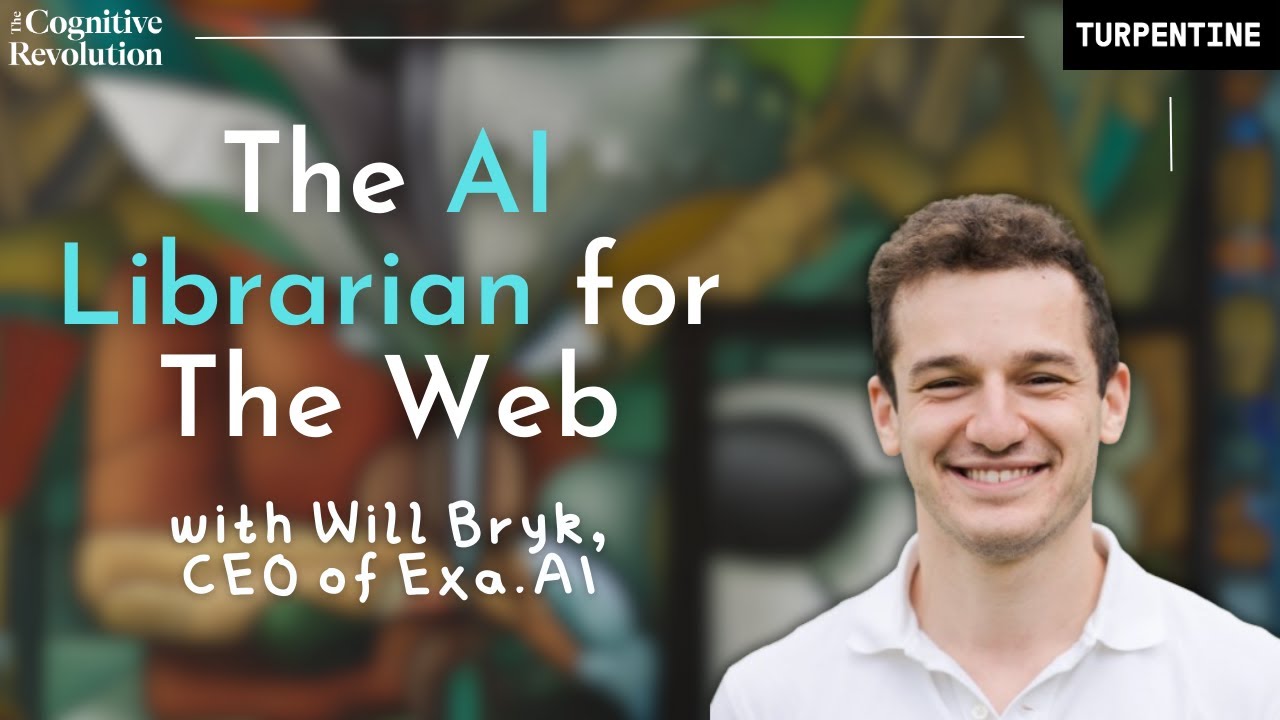
The Example Engine: How Exa Is Creating the AI Librarian for the Web with Will Bryk, CEO of Exa
Nathan and Will Bryk discuss Exa.ai's advanced search capabilities, AI methods, and their unique vector database in this insightful episode.
Watch Episode Here
Video Description
In this episode, Nathan sits down with Will Bryk, CEO of Exa.ai. They discuss how Exa enables complex, research-based searches that differ from traditional keyword-based search, how their AI uses neural and non-neural methods, why they are using their own vector database, and more. Try the Brave search API for free for up to 2000 queries per month at https://brave.com/api
LINKS:
- Exa.ai: https://exa.ai/
X/SOCIAL:
@WilliamBryk (William)
@labenz (Nathan)
@ExaAILabs (Exa)
SPONSORS:
SPONSORS:
NetSuite has 25 years of providing financial software for all your business needs. More than 36,000 businesses have already upgraded to NetSuite by Oracle, gaining visibility and control over their financials, inventory, HR, eCommerce, and more. If you're looking for an ERP platform ✅ head to NetSuite: http://netsuite.com/cognitive and download your own customized KPI checklist.
Omneky is an omnichannel creative generation platform that lets you launch hundreds of thousands of ad iterations that actually work customized across all platforms, with a click of a button. Omneky combines generative AI and real-time advertising data. Mention "Cog Rev" for 10% off www.omneky.com
The Brave search API can be used to assemble a data set to train your AI models and help with retrieval augmentation at the time of inference. All while remaining affordable with developer first pricing, integrating the Brave search API into your workflow translates to more ethical data sourcing and more human representative data sets. Try the Brave search API for free for up to 2000 queries per month at https://brave.com/api
ODF is where top founders get their start. Apply to join the next cohort and go from idea to conviction-fast. ODF has helped over 1000 companies like Traba, Levels and Finch get their start. Is it your turn? Go to http://beondeck.com/revolution to learn more.
TIMESTAMPS
(00:00:00) - Preview
(00:01:52) - Exploring the landscape of information retrieval tools
(00:14:19) - Exa: AI librarian for the web
(00:15:32) - Sponsors: Netsuite | Omneky
(00:16:57) - AI Project Ideas
(00:22:26) - What does search built for AI mean?
(00:25:40) - Ranking with neural and non-neural methods
(00:28:46) - Sponsors: Brave | On Deck
(00:33:13) - Best practices for Exa prompting
(00:34:01) - The power of keyword search
(00:37:26) - Breaking down complex queries
(00:34:37) - The evolution of search engines
(00:39:53) - The business side of Exa
(00:40:17) - The challenges of building a web scale index
(00:39:53) - The business side of Exa
(00:50:59) - Vector DBs
(00:58:17) - Company culture and core values at Exa
The Cognitive Revolution is brought to you by the Turpentine Media network.
Producer: Vivian Meng
Editor: Graham Bessellieu
For inquiries about guests or sponsoring the podcast, please email vivian@turpentine.co
Full Transcript
Transcript
Will Bryk (0:00) I think there's an interesting distinction between search and research. Google is a search engine. You know? You kinda know what you're looking for, but when you don't know what you're looking for, it's you're more doing research. And I think that's where Exa shines. What we're doing at Exa is we're kind of, like, trying to take all the world's knowledge and putting it into a new type of database, like a neural database. I like this database analogy because it's not really search. It's like you're kinda like with every query, you're filtering the database of all the knowledge into just what you need. There's a problem with, you know, search engines like Google is, like, you search something, and they say, you know, 33,000,000 results at the top. Like, what am I supposed to do with 33,000,000 results? There's no way all these results are actually what I'm asking for. So it's just like you just feel overwhelmed. From the product perspective, like, not every query should require the same amount of compute. Like, Google has kind of made this assumption that, like, no matter what query you type in, it takes a few hundred milliseconds. But certain queries are extremely complex and might require, like, scouring the Internet for, you know, maybe even seconds or or minutes. Thinking of it as more the optimal trade off is cool. It's like you're always optimizing for exactly the amount of effort to put into the thing.
Nathan Labenz (1:04) Hello, and welcome to the Cognitive Revolution, where we interview visionary researchers, entrepreneurs, and builders working on the frontier of artificial intelligence. Each week, we'll explore their revolutionary ideas, and together, we'll build a picture of how AI technology will transform work, life, and society in the coming years. I'm Nathan Labenz, joined by my cohost, Erik Torenberg. Hello, and welcome back to the Cognitive Revolution. Today, I'm excited to introduce you to Will Bryk, founder of Exa.ai, a company building a new kind of search engine designed with AI systems and workflows in mind. Noting that Google has limited people's imaginations about how to search the Internet, Exa aims to help people surface things that were previously impossible to find. Now if you've been following the show, you know that I've been exploring a variety of exciting new information and knowledge retrieval tools over the last few months. Today, ChatGPT remains my go to workhorse for ad hoc coding and other random tasks. Though recently, Gemini Advanced and now Clog 3 are both gaining share. Meanwhile, Gemini 1.5 Pro has become my favorite for all write as me tasks, including creating the first draft of this introductory essay, which I did edit quite extensively, but nevertheless, saved me a lot of time. Perplexity is still my go to for quick and accurate answers to specific questions, but you.com research mode has now taken the prize for deep dive multi page research reports. And meanwhile, Elicit is the most useful for structured systematic academic literature reviews. So in this increasingly crowded landscape, where does Exa fit in? Well, for 1 thing, while most of these products are aiming to provide answers to questions, Exa still returns links like a more traditional search engine would. After playing around with it for a while, I've realized that it's the quality, the controllability, and the depth of results that really sets Exa apart. And I've come to think of it as an example engine. To understand how valuable this can be, consider that just about every company I talk to would like to scale highly personalized communications, whether for lead generation, recruiting, or something else. Today, language models make this dream realistic. Given a list of leads or candidates and a bit of information about them, a language model can personalize your outreach at roughly human quality and far more scalably than was ever possible before. But where does the list itself come from? If the inputs to such a process are low quality, then the whole process will be garbage in garbage out. And this is really where Exa shines. Given a complicated multipart query, which can be up to a full paragraph in length, something that you wouldn't even bother to try with Google, but which language models can very quickly generate, and optionally, an example of what you're looking for. Exa returns lists of a certain type of result, whether they be companies, people, how to articles, you name it. And then you can feed those examples into your broader AI workflows. In this conversation, we get into not only how Exa supports previously impossible to scale use cases, but also how it works under the hood, including the nature of their web index, the reasons they are rolling their own vector database, and how they are planning to extend their functionality with knowledge graph like structures in the future. Will's ambitions for Exa are huge. He aims to build a leader in the new information landscape. And my experience with the product suggests that Exa's API business is likely to be booming for the foreseeable future. And also that the ways in which information is found and processed across the economy may change even more dramatically than all the new web experiences suggest. As always, if you're enjoying the show, we appreciate it when you take a moment to share it with friends. I expect that everyone will find value in this episode, but I would particularly encourage you to send it to anyone you know who's building AI task automations and who would benefit from bigger, higher quality input lists. And, of course, we always welcome your feedback. I have accounts everywhere, so please feel free to DM me on the network of your choice. Recently, a listener named Ashwin DM'd me on Twitter to offer to send me a piece of original art. And if you're watching the video on YouTube, you can see it right over my shoulder. He did not ask for any promotional consideration, and I certainly can't promise to promote everything that folks might send me, but I was super flattered to get such an offer. I'm happy to point you to his website ashwins art studio dot com for more of his detailed and intricate drawings. Now here's my conversation with Will Bryk, founder of Exa.ai. Will Bryk, founder of exa.ai.
Nathan Labenz (5:58) Welcome to the Cognitive Revolution.
Will Bryk (6:00) How are doing? Glad to be here.
Nathan Labenz (6:02) I'm excited to talk to you about what you are building with Exa. It is a AI first search product, and we're we're getting get into all the nuances and details of that. And really a a quick different 1 that has caused me to think deeply about how I think about the different ways that I go about searching for retrieving and and processing information. So I think this is gonna be a really fun conversation. For starters, you wanna just kinda give us a little bit of context on who you are, what Exa is, and how you are thinking about the world of information and how that contrasts against knowledge.
Will Bryk (6:38) So Exa is a search engine built for AI systems. Really, we're trying to redesign the search algorithm itself. You know, like, people have been used to Google for a long time, but now we have technologies like g p 3, g p 4 that understand text at the level of a human. And so the inspiration for Exa was what if we combine the power of language models, which feel like they understand text at near human level with search, which had feel like it hasn't changed in, like, you know, a decade. And that's what we set off to do, and we've been working on it for a couple years. We're really really like a research startup, so we have our own GPU cluster. We train our own foundation models for search, really trying to just, like like, ultimately solve the hardest queries, the the most complex ones that Google is really bad at.
Nathan Labenz (7:23) I read, extensively through your website. 1 of the quotes that jumped out at me there was, 1 thing we've realized is that Google has actually limited people's imaginations when it comes to what you can find on the Internet, and we are still expanding our conceptions ourselves. I'd love to hear a little bit about that kind of intellectual journey. Maybe you could start with what are some of the queries or questions or information needs that you think are not well served by Google or the, you know, the the last generation of of search options? And then, you know, maybe tell a couple stories along the way of kind of moments or use cases that have changed how you think about it.
Will Bryk (8:02) It's funny. People think that search is solved. Like, Google has basically solved web search. When you start thinking about it more, you realize there are all sorts of types of queries that are just, like, completely unsolved. Like, for example, you don't go to Google to find a list of startups that are applying AI to law. Because when you search search that on Google, a list like, a start up applying AI to law, you don't just get a list of startups. And then, certainly, when you start adding more modifiers, like start ups applying AI to law in the Bay Area, you don't just get a list of start up applying AI to law in the Bay Area. You keep adding making the query more and more complex. You realize, like, wait. Google is just not doing that. And then more broadly, anytime you try to get information and you're not using Google, it's because Google has failed you. So if you're going to LinkedIn to find people or PitchBook to find startups or Twitter to find high quality news, it's because you can't find that on Google. You don't know the right keywords to search. Like, even if you're trying to find a date, like, you're not going to Google because Google is not, like, a complex it's not a powerful enough search engine to, like, filter the all the world's information because a lot is out there into exactly the knowledge you want. And so our vision is be able to, you know, in real time, take the petabytes of information that's out there and filter to exactly what you asked for, exactly the knowledge that you want as fast as we can.
Nathan Labenz (9:20) So the example of startups applying AI's law in the Bay Area is 1 good example. What other, kind of key queries or sort of, you know, canonical use cases come to mind for you? Especially, I'm interested in this this process of expanding your own conception.
Will Bryk (9:37) There are so many. Okay. So, like, I want to find a designer, and I I I know of 1 that has a really cool style. So I have a maybe okay. Let's say I have a a web page of a designer that I really like, and I wanna paste it into Google and find similar designers. You can't do that. Like, similarity search is just something that's really hard when you're when you don't like, again, like, when you don't know the right keywords, Google fails you. And so when you try to do similarity search, it's like, you know, searching with, you know, a huge web page as a search itself, and Google just can't handle that whereas Exa can. Yeah. Like, searching for people, like, wanna find, like, researchers, like, in the Bay Area that have Rust experience. Like, Google does not give you, like, a list of researchers. So you wanna find people. You wanna find companies. You wanna find really high quality articles that have a certain argument. So, like, articles that really go deep into, like, the power of Rust over Python for multiprocessed applications. Like, you don't think to type that into Google because, you know, it's just not gonna work. Yeah. There it's really just, like, there's any sort of complex query that you might wanna make. Google fails.
Nathan Labenz (10:46) Yeah. Okay. Interesting. So I have been kind of on a you know, my own personal journey of trying as many of the new information products as I can get my hands on over the last several months. We've actually had a few founders of other notable companies on the show as well. So we've had Arvind from Perplexity. We have a an episode with Richard Socher from you.com, and we've had the founders of Elicit on as well. And maybe I would just kind of compare and contrast a little bit my experience with Exa against, you know, not just Google, but against those. And I would try to come up with kind of the right label or sort of category name for each of these products. They're they're all a little bit different, And it's it's quite exciting actually to see that there are just people going in conceptually different directions and not just competing, you know, 1 for 1. So when I think of perplexity, I think of kind of answer engine. It's like I go there if I have a question and I want the fastest, most kind of clear accurate answer to it. I think they do really well with that. And they give you an answer, you know, in paragraph form. I go to you.com these days. I think of that a little bit more as a autonomous research assistant where especially in research mode, which is my favorite mode from you.com. I can give it kind of a multipart question, and it'll go out and do, like, multiple rounds of searching, processing the pages, trying to synthesize the results. And then with illicit, I think of that as more like a structured literature review tool where it brings results back, not in paragraph form, but in, like, tabular form. And it's like, here's all these papers and here's these different dimensions and here's how and they're very focused on academic content. And here's how, you know, we sort of assess each of these papers on each of these dimensions, and you can kind of add columns. And you end up with something that's, like, a very structured sort of layout of the information that you're that you're engaged with. Exa, I am using the term example engine so far. And I think what is really interesting about the Exa experience is that the input is very different, and the nature of the results are are very different from what you would see with Google. But the sort of presentation is actually maybe in some sense the most traditional in that it like, it gives you kind of a list. But I guess I have a number of questions like that about this. Like, 1, how do you think about the example engine label? You can compare and contrast to the other ones, you know, as much as you'd like. And I'm interested in kind of, you know, a number of the design choices. But let me just let you react to all that first.
Will Bryk (13:20) The the label is difficult because, like, even when you've built been building it for a long time, don't really know the exact thing to call it. I'd say it is particularly good for research. So maybe a research engine might work because if you think about it, like, Google and a lot of these the the tools you mentioned are built on top of Google, and they add some sort of post processing stuff. So but, ultimately, they're still the results they're using are are based on, like, a keyword like search engine that Google uses. And I think there's an interesting distinction between search and research. Google is a search engine. You know? You kinda know what you're looking for. You know, Taylor Swift boyfriend. You type into Google, you get you get that thing. Or, know, you search my name, you get, like, content surrounding my name, and you know what you're looking for. But when you don't know what you're looking for, it's you're more doing research. And I think that's where Exa shines. You type in, like, a natural language prompt, we call it, explaining the type of thing you want, and and you get a list of things that match that. So I think research engine it's kinda like a Exa feels more like a library. You go to you go up to the library and you say, hey. You know, I'm looking for startups applying AI to law. You don't know the right keywords to use there. Like, some of the startups applying AI to law might not mention AI or law. They might say we take, you know, a certain machine learning algorithm and apply it to legal documents or something even, like, even less keywordy. And and the librarian, like like, knows a lot, you know, very smart and is able to, like, point you to the things that that match that. It's more like a research like experience. And, yeah, in terms of the UI, you know, we're really focused on the API. And the UI, we want people to just you know, we always want people to be able to use Exa, and we are figuring out the right user interface. Right now, it's a list of links, but that's not ultimately, like, the right user interface for consumer search. I I certainly like, it's certainly, like, LLMs will and are a huge part of the right consumer interface. And I think there are really interesting things coming there that we're gonna explore. But we're yeah. Right now, it's just we wanna, like, just show people exactly what the API returns. But I think more we're gonna move towards a consumer interface that is more like the products we want people to build with Exa. So more like a researcher type type interface.
Nathan Labenz (15:28) Hey. We'll continue our interview in a moment after a word from our sponsors. Okay. So that's maybe a great segue to what are some of the things that you have seen people build or want people to build that you think are most exciting. And I I can say, you know, in just kind of testing this and working with a friend of mine who introduced us, who he and I are working together on a a number of different kind of prototype applications for this company Athena, where we're both advisers. He has done some really cool stuff with similar companies, similar candidates, you know, similar articles kind of creating, like, synthetic thought leadership or synthetic plans. He put he uses it for you know, if you want to because the assistants a lot of times don't have the expertise, but they it's the theory is it's out there. Right? So he showed a great example the other day of I want to increase my oxygen capacity in my lungs. And what do I do? You know, that's 1 of my goals. But how can the assistant help? Unfortunately, the assistant in general is not gonna have a lot of expertise there, But what we're starting to patch together is like, well, let's go find some expert content about that. That's where Exa comes in. Like, here's a list of articles about how to, you know, improve your lung capacity. And then, you know, further processing downstream with language models, can get to, like, practical steps. So maybe we could order, you know, this machine, or maybe we could sign you up for this, you know, online exercise course or whatever. Right? You can start to go from the goal to unpacking the goal with hopefully expert content and then, you know, starting to to create concrete actions that the assistant can can actually do for you and advance, you know, help you advance toward your goals. That's the sort of thing that we've been experimenting with, but I'm sure you have many more scenarios. I'd love to hear about, some of your favorites.
Will Bryk (17:21) Yeah. People build all sorts of things from, like, the very businesslike and and, you know, professional to the wacky. And so just an example, like, 1 tool I I'm particularly proud of is it's a paper writing tool that helps people write papers, and it uses ChatchPT to present so many different ideas for what to write next and can unblock you and may inspire you to think of, like, new ideas. And but Chatch BT, you know, is not smart enough to do that on its own, so it needs to rely on a search engine. And if it relies on, you know, a traditional search engine, it's pretty limited. It's not it can't search in all these powerful ways. But when it uses Exa, it's able to recommend, like, really good papers that really exactly match the type of thing you're writing about or exactly, like, follow the type you know, you could you could say, like, what's a paper that follows this idea? And you could paste the idea. Like, you know, like, that's a crazy type of search that you can't do on Google. Like, here you know, here's a paragraph or 2, and then, what's that idea that would naturally follow this? You could do that with Exa. We're helping academics learn about their field because they've, for 2 decades, been using a tool that was limited in certain ways, and now we're, like, opening up the world to knowledge. Like, that's that's exactly what I got into this for. And then okay. So that's just 1 example. Like, another tool that I'm happy about is, you know, a tool for VCs to, like, source companies. So it's, again, like a Chatch BT, like, product, like, interface related to the chatbot, but the Chatch BT is recommending, like, startups to go investigate. And and the VCs would not find these startups if it weren't for Exa. So it's kinda like we're connecting in a way it's like we're enabling a marketplace of startups to VCs. Like yeah. So you could enable new marketplaces through better search. And then wacky things, you know, like, people have people have, like, made apps where they can meet people in real life because of Excel, like, you know, like, thinking dating app. You know, you do, like you know, you paste someone's, profile, and then you get, like, you know, 20 different people who are similar. So, like, people search is very powerful. I I know someone who has met several people in real life because of Exa. That's cool to see, like, the digital to the real. And, like, it's it's Exa is a very fun search engine. So people beyond just, like, tools people are building, people are just finding like, they're seeing the world in a new way because of Exa. Like, at at 1 point, we had rediscover the Internet as the the title on the the consumer page because that's really what's happening. It's like, there was this Internet. It was always there. There was all these not like, things, like, really interesting things that were there, and you just didn't know about them. They were hidden because of the algorithm. And so and because we changed the algorithm, those things are now revealed. And so some someone described it as, like, uncovering, like, a hidden temple of knowledge or something, which yeah. It's it's amazing. And there there are, like, infinite insights on the web from, you know, documents that you haven't already found, but also from combining documents. Chatbitee can do the combining, but it needs the the right inputs. And, so, really, when you combine Exa to, like, find all those, like, 100 documents that are relevant and then you have you combine Exa with, like, an AI like GPT 4 or eventually GPT 5, that's when you get, like, absolutely magical experience. We're the knowledge engine. G Cheddar BT is the combining engine. So I I why why a lot of our products, like, they use AI. Right? Like, again, like, we're a search built for AI, so all these products I described, they're like Exa is being used by an AI system. That's when you get, like, the most the most juice from what we're doing.
Nathan Labenz (20:43) So what does that mean, a search built for AI? I mean, I think that's a very provocative phrase, and it definitely, you know, has a strong point of view around where the world is going. I don't immediately know what that means, though, in terms of, like, how that cashes out. Like, how are the results different, or how are you you know, what what are the demands of AI as a consumer of search results? How how is that different from the human needs as a a user of search results?
Will Bryk (21:13) If an AI is doing the searching, it's very different from a human doing the searching. So so, I mean, for a few reasons. 1, like, human is lazy and types in a few keywords max. Right? Like, a human doesn't wanna type in a few like, a paragraph explaining what exactly, the human wants, whereas an AI could instantly open a paragraph or 2 paragraphs depicting exactly what it wants. So you want a search engine that can handle the complex queries that an AI can make. Like, Google was optimized for very simple queries, like Walmart homepage. Like, it's things like that. And okay. So that's 1. Also, you know, AIs can take a 100 results and instantly gobble up all that information. Whereas humans, you know, we we search, and then we click on a few a couple links and and read them and move on. So that means, like, you want a search engine that can return, like, not just a few links and a few quality results, like, a 100. You also like, humans, when they search something, like, again, like Taylor Swift, we don't really know what we want, and we kinda just want, like, a diverse array of things related to Taylor Swift. Whereas when an AI searches, it knows exactly what it wants, and it asks for that thing. So if it wants a list of companies, it'll ask for that, and then it wants a list of a 100 companies. It doesn't want, like, 1 company and then another blog post about companies and then a LinkedIn post and then some Reddit forum. It it knows what it wants. It it it you just want a search engine that is, like, controllable and can return it exactly what it wants, exactly the number of results, handle complex queries. And then the last thing is that, yeah, they don't want links and titles. They want, like, full page content. They want, like, exactly the content itself because they don't wanna they don't wanna get a links and then have to, like, go wait in a browser and read that thing. They wanna just, like, get all the information at once. So you need all these features if you're gonna be serving an AI, like, really well. You could you could connect an AI to, like, Google, but now now you're just connecting this, like, completely new creature that has, like, all these different properties to something that was designed for, you know, organic humans, and it's just, like, not a good pairing. Like, this is such an important part of the human experience, the way we find information. Why are we why are we using some old technology for some super new thing?
Nathan Labenz (23:24) So the 3 things that I heard there, tell me if I missed anything. 1 is because the language models are just so quick at generating text, they can do much deeper, more robust queries, you know, with no effort. Right? As opposed to humans just don't sit there and type paragraphs. So you wanna be able to handle that. Second, you can handle a lot more information coming back. So you, you know, you wanna return more. And third, instead of links, you wanna return actual content. You also mentioned something about types. Basically, controlling the type of the of the response as opposed to just, you know, kind of whatever. So that's all really interesting. How does that compare to in terms of, like, starting to get into a little bit of how it works? I know that Google obviously has moved somewhat in this direction. Right? I mean, the the original thing was PageRank. And I actually don't know if you're using any sort of, like, PageRank type algorithm in in your system, but they certainly have moved toward, you know, some sort of BERT, you know, whatever, you know, the successor to BERT where they are embedding content. You can do at least some amount of semantic querying there. Right? But how would you contrast, you know, the I guess, on those key performance dimensions that you outlined, how would you contrast Exa against Google today? I actually don't know what really it's an interesting point. I don't know what would happen if I put in a full paragraph into Google. Does it just still say, like, sorry. There are no results for that, or that's an interesting experiment that I've not done?
Will Bryk (24:51) It doesn't, like, do what you ask it to do. Like, you know, if you tie if you paste, an abstract of a paper, for example, and you say, like, similar papers at the bottom, like, it's gonna give you a bunch of results that are the same paper. It's like it's like finding, like, a bunch of examples on the web where people have where that paper exists, as opposed to finding similar papers. So it's not like it's definitely not handling those kinds of query. Mean, you could experiment with more of those, but, like, it's just not meant for that. In terms of of how the Google algorithm, like, contrast with our algorithm, it is totally different. So with Google, I mean, no 1 knows exactly how it works. But in terms of their BERT stuff, like, it seems more like a re ranking at the end. So it's like a post processing step. So maybe you do you do an initial filtering of the entire web to, like, some number of results, and then you re rank with some neural method. And that's very different from going neural from the beginning because, you know, you will just miss things that are that are not in that first filter set. Like, if you filter to 10,000 and, you know, if you miss things that are relevant, it just the the re ranking won't won't help. But, I mean, their algorithm is, of course, like, more when I say keyword based algorithm, it's more complex than that. It's Google. I mean, it it is very effective for what it's trying to do. And they have, like, a knowledge a knowledge graph that they you know, when you when you mention Obama in your query, it's gonna, like, know about it's gonna take some information from Obama from the knowledge graph and input that into your query. So it's more complicated, but it's fundamentally like a keyword based algorithm. It's like looking at keywords. And whereas our algorithm is we train, like, a transformer like model to predict links. And so the way it works is we we find places on the web where people talk about links. So imagine imagine, like, a Reddit comment where someone says, you know, yo. Check out this cool aerospace startup, and they paste a link after. We we hide the link and ask the model, you know, predict take that text and predict which link followed. And if you do that, like, hundreds of millions of times, you get a really good search engine out of that. Because at search time, someone's, like, aerospace startup, and the model predicts the most likely links to follow. And so in some sense, this is like page rank. It's more like an like a neural page rank. It's like a it's like a learned page rank. You know? It's the if the model often sees people ref when people say a great fundraising essay, they often refer to a Paul Graham essay, then the model learns, okay. When people talk about a great fundraising essay when someone searches for great fundraising essay, you know, let's let's let's hit them with the Paul Graham 1. So it it is like a learned page rank. But, I mean, that's just v v 1. You know, for v 2 and v 3, we have, like, some really, really cool, exciting things coming up. So
Nathan Labenz (27:30) To the degree that you wanna share more about that, I'm keen to hear. But before we even get to v 2 and beyond, to just be a little bit more concrete about, like, exactly how it's working, it's it's very interesting that you are starting with this conversation about links. When you're actually you also said transformer like model. I'd be interested to know more about that and, like, what exactly the like part of that, transformer like means, you know, what sort of deviations there are. But I imagine you're not, like, doing because you could do that in ChatGPT as well, or you could be like, complete the following. Here is a great essay on fundraising, HTTPS, you know, colon slash slash and see what it comes up with. And a lot of times there, you know, we'd predict token by token, www.whatever.com slash whatever. And sometimes it might generate real links. A lot of times it would generate made up links and link you to nowhere. So I assume you're not doing, like, literal token by token link prediction that way. Can you give us a little bit more on kind of what makes the the model transformer like and sort of a little bit more concretely, like, what exactly is being predicted at runtime? Hey. We'll continue our interview in a moment after a word from our sponsors.
Will Bryk (28:46) That's correct. They were not we're not predicting it token by token. We're really so we have an index of documents, and the model is trying to predict which documents. So it really ultimate it's trying to instead of predicting a link, it predicts just like a document ID, and so it's not generating the link. And it's transformer like because you can't you can't just use us you know, if you take a transformer and try to do what you're doing with the with predicting the next token of the link, like, it's just not gonna work because you're forcing the model to memorize URLs, and that that just doesn't work. So so you can't just naively take a transformer and fine tune it for this objective. You have to create a new type of objective. So we have it's an embedding space approach. So, like, our the transformer ultimately outputs an embedding, and you start using that embedding. But, like, doing that at scale and very precisely, that's where a lot of the the the research that we did for, like, really, like, a year when we started this, we could talk about. It was, like, really exciting. Like, very few startups actually do, like, research into what they're doing for a year before they, you know, ship product on top of it.
Nathan Labenz (29:52) Yeah. Google come comes to mind as 1 that did at least some serious work before launching back in the day. So it makes sense that I mean, I think the embeddings the future of embeddings, I think, is gonna be extremely interesting in many ways. And, you know, I've had this kind of hypothesis for a while that more and more communication is going to be mediated by embeddings as opposed to being mediated by natural language. As systems come to talk to other systems, I think in many cases, it's just not gonna make a lot of sense for that to be reduced to, you know, a a string linear string of of natural language tokens and then kind of, you know, reprocessed. If on both ends, have AI systems that natively work in, you know, some sort of embedding space, then, like, some sort of translation from embedding space to embedding space seems like a lot more efficient, a lot less lossy. Also, lot more problematic in some ways in that it's, like, becomes very hard to know what is going on, you know, and they're like, we can't interpret that always very well or, you know, we can't interpret it in the same way that the that the systems are interpreting it, certainly. So I think that's, like, really interesting, and this sort of feels like a little bit of a glimpse of, you know, this aspect of the future that I've been kind of anticipating.
Will Bryk (31:12) Embeddings actually feel to me like the past. I think I think embeddings are just the beginning. I I I I would be disappointed if embeddings are the way we're passing around knowledge in the future because embeddings really do lose a lot of information. Know, particularly if it depends how many embeddings you obviously, if you have if you take text and you output a 100 embeddings, then you're not losing information. But if you're taking text and outputting an embedding and then doing a dot product with other you know, the document embeddings you have in whatever index you're talking about, that dot product operation is just, like, lossy. Like, you're it's not gonna be able to handle all the types of complex queries you might wanna do. So our our thing is embedding space right now, and it's really, really powerful embedding. It's like we really, you know, squeeze out as much juice as you can from from embeddings, But embeddings are still fundamentally limited. Like, they can't do complex operations. For example, like, startups applying AI to law in the Bay Area where the founders, you know, have experience in Rust and blah blah blah. You keep adding more modifiers. Like, you cannot expect a a single embedding and a single dot product to to handle that kind of query. So when I talk about v 2 and v 3, that's what we're talking about, like, moving beyond embeddings. So embeddings are definitely a step up from, you know, not no neural, but like, at least right now, the best systems are probably gonna combine keyword based approaches and embeddings approaches. But, ultimately, like, you could do way more powerful things. Maybe you could think of it as, like, there's a spectrum between an embedding dot product and, like, a full transformer output. Like, you know, an embedding dot product is a very simple operation and, like, a full so, okay, imagine, like, the you take just more specifically, you take the embedding of a query and the embedding of a document, and you take a dot product. You get a score. On the other side of the spectrum is, like, you put the query text and the document text in the context window of the transformer, and it goes through all the weights of the transformer and outputs a score. This 1 took a huge way way more compute than this 1, so it's a much more powerful operation. It's just hard to do this 1 over the whole web. This 1, could do over the whole web. So are there things in the middle that are unexplored? I think so.
Nathan Labenz (33:13) And it's probably worth kind of describing a little bit how Exa is best prompted, which I I noticed it's it's interesting you kinda have your best practices, and then you also have, like, an auto layer that allows people to kind of use the sort of keyword search that they're used to using and translates it into the best practices for Exa prompting. Maybe just give a give a little account of that first, and then that'll, I think, shed light on, you know, the the the underlying technology.
Will Bryk (33:39) Sure. Yeah. Because the model was trained to predict that, let's say, document ID. So, like, you know, check out this aerospace startup link. That means that the best way to search Exa right now is to search in a way such that a link follows your text. It's a little strange, but, like, you know, type a query, type a prompt such that a link the link that you want follows. So if you really want the model to output startups, the best thing you could do is, like, say, like, at the end of your prompt, do, like, parentheses, startup, colon. Like, that is the end of your prompt because what what follows that on the web when someone puts that? Obviously, a link to a start up home page. And so you're, like, really biasing the model to return exactly what you want. This is something we were actually considering putting on the the home page just like that it's a really powerful way to search Exa, is to prompt it in that way. And there are all sorts of prompting tricks that make it that that allow you to squeeze out the model. We're in a very similar state to, like, GPT 3 before our before ChatchwayT, before RHF. It was a text completion model. And so you had to prompt it in these weird ways, and it was hard to use. And then they, you know, RLHF'd it to make ChatVet. And that's great because it's easier to interact with, and now my mom could use ChatVet, But it also you lose things because RHF makes it less controllable. And from our perspective, it is a little harder to use, for sure, in this when it's you're using this model that requires, like, the text to you know, it requires in this weird format, but it it also, like, makes it a very powerful and controllable search engine. So we haven't, like, put a huge amount of resources into RLHF ing the model. Yeah. Also, a lot of our users are businesses who are happy to learn how to prompt well, or, like, they might even not be prompting themselves. They have, like you just tell Chatbitee to prompt it correctly, and it does that. So I think Chatbitee made our weird prompting scheme less less of a a negative.
Nathan Labenz (35:38) Yeah. Well, you certainly have to be willing to step outside what people are familiar with to create something new. No doubt about that. So under the hood, then it is if I understand correctly, the input is this text prompt that sort of tees up. Here's the kind of thing that I'm looking for. The model predicts an embedding. That embedding is then, you know, through a vector database, you know, find the k nearest neighbors or whatever from your existing index. And then those, of course, correspond to source links, and that's how you ultimately bring links back. It its prediction is in this, like, high dimensional embedding space. Is that basically how it works today? So then in the future, you imagine kind of elaborating that in multiple ways. I guess, you know, just hearing your example of, like, startup law Bay Area, these sort of, you know, conjunctive, you know, composite queries, my first, like, naive reaction to that would be maybe I want to kind of decompose that and have, you know, multiple different embedding guesses and then run multiple different k nearest neighbors and then maybe look for, like, the overlap in those resulting sets or, you know, have some sort of, you know, some sort of post processing heuristic on, like, which of you know, how to combine those results at the end. I guess you could also just have language models. You know, if you if your language models get fast enough, they could start to, you know, do the post processing for you. But how do you see that kind of evolving as as we go? And and what are the bottlenecks? Like, is it just that we're still inventing this stuff? Is it that the compute right now is not there to power all the things that you, you know, you maybe you know how to do them, but you just can't either, like, afford it or you can't it takes too long. I'm interested to hear, you know, both, like, where you think we're going and, you know, what what are the hard parts that that we need to get over to get there.
Will Bryk (37:24) That was a great intuition, and we are hiring. Breaking down the query definitely is a way to do this. It's subtle how you break it down, but for sure, that's that's I mean, certainly, mean, that's how humans do it. Right? Like, when you have this very complex query with lots of modifiers in your head, you break it down into the right components, and then you make sure everything matches each of those components. So, yes, that is a a very good direction. Then there are other things that even that will not help with, particularly if the knowledge is spread out across different documents. So, again, like, just taking that example we've been working with, like, startups applying AI to law that are in the Bay Area where the founders have Rust experience. Now on law and AI law websites, they don't usually talk about the founders and their Rust experience. So you need to combine information from other parts of the web. And so doing that is where that's where you start unlocking, like, super high value. And we we we have, you know, pretty clear ideas for how to do this. I don't wanna get too deep into that. But, basically, you can imagine, like, knowledge graph type approaches. And but, like, you don't want it to you don't ever want it to be a very discreet you always wanna be working in, like, a neural, like, fuzzy world because then it allows for, like, arbitrarily complex queries. Whereas if you have, like, a a knowledge graph that literally has Obama, books that he's written, those books have authors. Like, everything has, like, very discreet metadata. You're limited to just that metadata, where if everything is, like, in, like, an embedding, you know, fuzzy space, you could make complex queries over that graph.
Nathan Labenz (38:53) Training models to output things in embedding space is, I think, just a there's, like, a massive set of unlocks there coming for us. It it that seems pretty clear to me. I still quite underexplored.
Will Bryk (39:06) This is such a big unexplored space. Language models have been explored for the generative in the generative area, generating text, generating images, generating video, but really have not been explored too much in the improving the search algorithm area, surprisingly. Right? Like, there's a lot of value in it. And so it's just, like, a lot of really, you know, like, intuitive things like you thought of, like, haven't really been fully explored. You don't get a lot of PhD students writing papers about web search anymore. So it's just like there's this whole space of possible solutions. You need a company with the right incentives to go pursue it.
Nathan Labenz (39:41) Yeah. The best minds of our generation are elaborating chain of thought still, so, we gotta finish that up before we can get on to the next thing. So the index is interesting in and of itself. Right? The couple of things I've wondered about as I've been researching the company using the product. 1, from what I can tell online, you've raised $5,000,000. I don't I'm not trying to ask you to break any news here or share anything new, but either you're managing to do a lot of indexing on a relatively small budget or maybe there's more funding behind that that is not public yet. But I was kind of just wondering, how are you building a web scale index and doing what sound you know, have a compute cluster. Is it really on that small of a budget, or is there are there more resources that you have accumulated to make that possible?
Will Bryk (40:29) Yeah. I mean, we're we try to be frugal, and, there are lots of optimizations you can make that make this stuff not too crazy expensive. But, yeah, we're not also, we're we're not, like, crawling the entire web right now. We're crawling a very high quality subset of the web, the subset that our customers care about. And because we're not crawling the whole web, that allows us, you know, as a lower resource startup to, you know, pursue algorithms that are more complex and to just do it all on on a budget that makes sense. But, yeah, like, crawling, like, hundreds of billions of web pages continuously, which is what Google has to do, that's quite expensive. Crawling, you know, a lot fewer and and not on such a regular cadence, that's totally possible for a start up. I think this is a problem that other start ups have had in the past. Other search start ups, they've tried to to early on, like, be comprehensive when, you know, you're just gonna be okay at searching over everything as opposed to really good at searching over a few things. It's it's kinda like the the advice of, like, you know, do something that makes a a few people love you as opposed to do things that make a bunch of people like you for startups.
Nathan Labenz (41:34) I've recently seen Brave, the browser company, has an interesting offering where they basically have a, I believe, like, a web index as well, but it's based on where people are browsing. I don't know if you've seen that, but it that kinda reminds me of what you are describing. And I you could do something much more heuristic based if you just said, hey. Let's look at Reddit, and let's look at archive, and let's look at, you know, to pick your, you know, favorite 50 websites and, like, the things that people link to from there. I could see something like that also really taking you pretty far. But if you've looked at the the brave thing, but it it is specifically based on where people are going, where they are spending their time. And, you know, that seems like a really interesting way to to get a view on what is actual real content that people value versus and I I imagine it's gotta be, you know, just given the proliferation of stuff in general. I imagine, you know, 90 plus percent of time on the web must be spent on, like, under 10% of the pages. Right?
Will Bryk (42:35) Yeah. Yeah. I don't know the exact number there, but certainly, the links that people share is an interesting metric for what is high quality. So, like, our model is trained to predict what people share, and people often no 1 shares SEO blog posts. People share, like, that really good recipe. They don't share the SEO blog post about a recipe that's, like, trying to you know, that has all sorts of ads on it. So our model is really trained to predict links that are just give you, like, raw content, as opposed to, like, putting all sorts of ads and, like, stupid information in it. So it's, yeah, it's like our model is trained to not predict SEO. And and I I like, with Brave, it's like people often spend time on the things that are not SEO.
Nathan Labenz (43:16) Let's talk about the business for a second. I was initially kind of I'm just looking at the the pricing. It starts at basically $10 per 1,000 searches, and that is if you wanna get up to 25 results per, and then there's a higher price if you wanna get up to a 100 results. And then you can you know, things can go on and get more elaborate from there. You get the the custom enterprise option for people that want to, you know, to go beyond what the the standard plans offer. My initial reaction to that was like, seems a little expensive. Like, typically, a API product these days is, like, 1 to 2 dollars per thousand calls. However, as I'm talking to you and I'm thinking about this, I'm realizing that 1 thing I've said, you know, in the context of Athena and the the apps that we're building and the the things that we're trying to equip our assistants to do for their clients is almost every client that we have has a opportunity, if not a, you know, pressing need to scale some sort of lookalike search. You know, we here's some good sales targets that we've sold to successfully. I want more like this. Not easy to do. In today's world, you know, you could go search LinkedIn. You could do a number of different things, but definitely not easy. Similarly, here's a great candidate, you know, that we we want more resumes like this. Again, you can do that kind of on LinkedIn, but also not super easy. So I'm struck by those 2 use cases being, like, super ubiquitous. And imagining the more we talk, I'm like, that sounds like a significant part of the business. And if the results are good, first of all, for us at Athena with the assistance, it could really unlock the their ability to do that effectively because a lot of times they struggle. You know? It's like, yeah. We need a, you know, engineer with a certain background and skill set or whatever. And it's like, a lot of times that flies right over the head of the assistant, at least when they're first getting started. You know, they they just don't know. And similarly, target, what makes it good, what makes it not good. I imagine that there could be I wonder how you think about this when you're talking to customers about it, but it seems to me like investing a little more on the quality of the results saves you potentially a lot in terms of the iteration time to actually get something working and perhaps also the downstream language model processing of the results. So, anyway, that's all speculation you can react to it. But I guess, you know, what what are what are the kind of main, you know, business wise? Like, what are people really just coming back to and doing over and over again? How are they reacting to the price? And and how do you think about kind of your price versus other, you know, kind of complements in the overall systems that they're building?
Will Bryk (46:01) I mean, 1 thing that's interesting is a lot of customers are searching over a particular domain of things. So it's like, you know, they're searching over only people, or they're searching over only companies or searching over only news articles. And so they want a search engine that just returns them those things. So you just you just want a list of people that match your criteria, and it's just really hard to get Google or Bing to do that. And so customers come to us because they use Bing, the Bing API or wrappers on Google, and they're like, this just doesn't give us what we want. And so we just we need you. And so a lot a lot of the customers are are coming to us because they just need this. There's no other way to do it. And no 1 really complains about the price because it's just something they need. We can always work something out, you know, at high volume with with enterprise plans, and we've done that. But, yeah, it's just such a unique experience that we real we really see ourselves as, a premium search. Right? It's a it's search that you can't get anywhere else. So yeah. I mean, customers are using us for those domains that I mentioned often, but in various ways. It's not just similarity search. It's, like, you know, all sorts of downstream use cases. They're like it's too hard to to put them into 1 into particular patterns. Maybe you could put them into patterns of, like, some retrieval augmented generation use cases, then there are automated analysis use cases, and then there are even crazier ones like creating, like and getting, like, hundreds of thousands of results or even millions of results for for fine tuning models, really. There there are a lot of different types of use cases of the same product.
Nathan Labenz (47:34) Yeah. Interesting. I'm I'm coming up with some more ideas just listening to you describe that. And, yeah, I'd 1 I mean, it's interesting. Right? What's expensive? What's cheap is I think we're very much, like, getting used to a new regime here because on the 1 hand, you know, 1¢ per API call could be considered expensive. On the other hand, if you're comparing it to human labor, it's extremely cheap. So, you know, the quality is obviously the real determining factor there. I'm not 1, by the way, to emphasize the cost too much. My general advice to people building apps is costs are coming down across the board. And right now, the first question usually is, can you make something that meets your needs? And I would do that using the very best tools, you know, whether it's GPT-four or Exa, you know, whatever the best tool is, like, use that, maximize your performance first, and then later on, you know, you can upgrade to an enterprise plan for savings, or you can, you know, wait for savings to kind of just generally secularly arrive, or you can optimize in any number of ways. But don't do that too early because then you may miss the fact that, like, maybe you could have actually built something that worked and you, you know, you didn't even get there because you were too budget conscious too soon. So I don't mean to suggest that, that I'd be too concerned about the price. My my advice would be to anyone listening, like, definitely use it if it is the best thing for you. And I I think for a lot of these use cases that we've been discussing, it seems, you know, like it very likely would be. How do you handle evaluations? This seems like a a challenge. You know, it's a challenge for every AI startup. It seems like you have kind of a maybe a unique flavor of that challenge.
Will Bryk (49:18) Yeah. This is a this is a difficult problem because it's very subjective. So, like, if you evaluate Exa on the types of queries that people use for Google, then, obviously, Google is gonna be better. And if you evaluate Google on types of queries that are great for Exa, then Exa is gonna be better. So, like, what distribution of queries are you sampling from? And, I mean, we have anecdotal evidence that, you know, a lot of our customers are you know, they're going to Google if it's failing them, and then they come to us. But that's not a quantitative metric. There are, like, you know, web retrieval datasets, but they're again, they're often, like, designed for the old way of searching. So we've really had to, like, come up with our own internal metrics for comparing our search to other methods. And, you know, 1 way to do it, 1 interesting way is to break down instead of, like, you know, just sampling queries and being like, is this good? It's more you break down the model into different abilities that it could have that you want it to have. So, like, for example, like, you want it to be able to handle authorship. So if you say, like, essays by Paul Graham, you get essays by Paul Graham. That's better because that that's objective. Like, there's no subjectivity. Like, does the does the result match that query, like, authors by program or that part of the query? And so you could do other things, like not just authorship, but topic. You know, this is about space exploration and make sure it's about that. So if you break it down to abilities, you've turned the subjective problem into an objective problem. There's well but it's still, like, a lot of internal datasets. So not nothing like you can't find this kind of thing on the web or or sorry, on, like, you know, open source datasets that you could then compare benchmarks to.
Nathan Labenz (50:58) Interesting. Definitely a challenge. So internal internal evals, basically. How about the vector database technology? That's something that a lot of people are, you know, 1 to 2 years behind you on where, obviously, you've been, you know, working on this stuff for a while and have probably seen pros and cons and different trade offs. A lot of people right now are like, maybe are either about to or have just, you know, done their first vector database prototype. How would you I guess, you know, if you're if you'd be open to sharing, I'd be interested to know, like, specifically what are you using and, you know, what are the kind of most relevant trade offs that you have encountered. If you don't wanna go that deep, then I'd love to just hear kind of what you have observed broadly, what you think people should be considering when they're choosing a vector database, and kinda where you think that class of technology is going.
Will Bryk (51:43) Yeah. Sure. So we build our own vector databases. Just following the trend that we're gonna build vector databases. But I think we have a good reason because we're doing web scale, search and but it's particularly we have all sorts of filters that we wanna apply to the query. So it's we're not just doing a simple, you know, nearest neighbor lookup. We're doing more complex things than that. And so, like, these Vector DBs were not designed for all the different types of filters we wanna apply. We I mean, we of course, we have looked into the open source VectorDB, like, offerings, and I just compared ours. And, you know, ours works way better for the type of searches that we're doing. Definitely yeah. It's gone it's gone through, like, multiple versions. There is a it's a really interesting problem. We've had a lot of fun with our own vector database. But 1 way you could think of what we're doing at Exa is we're kind of, like, trying to take all the world's knowledge and putting it into a new type of database, like a neural database. I I like this database analogy because it's not really search. It's like you're kinda, like, with every query, you're filtering the database of all the knowledge into just what you need. And so, like, when you search for startups applying AI to law, you should get, like, 367 results. These are all the startups applying AI to law. And when you add Bay Area, it's like a filter to the database, and now you get, like, instead of 367, it filters it to 54. And so just thinking about the world's knowledge as a database, it makes it it makes it feel like everything is actually, like like, you have comprehensive knowledge of what's out there. Because a problem with, you know, search engines like Google is, like, you search something, and they say, you know, 33,000,000 results at the top. Like, what am I supposed to do with 33,000,000 results? There's no way all these results are actually what I'm asking for. So it's just, like, you just feel overwhelmed. And then, like, the the things that are returned are not actually exactly what you're asking asking for. So yeah. Anyway, so, like, we're trying to build, like, a new type of database that's, like, combines neural and non neural methods. And if you're we're trying to do that, then it makes sense to build our own.
Nathan Labenz (53:36) So combining a couple of the threads, it sounds like you're almost if I had to guess it, it would be like your vector database maybe has, like, multiple vector representations of each thing where they're, like, kind of projections in various directions. Like, you have a certain essay, but then you could project it in the authorship direction, or you could project it in the you know, you could project startups, you know, into a geographical direction. And then that maybe starts to open up this, like, multidimensional query, but still staying in, like, the fuzzy embedding space, as you said, is important earlier. Is that is that kind of the direction that this is going?
Will Bryk (54:16) I think that would be there would be a problem there because, you know, there are a huge number of possible directions. So you are you gonna make an embedding for authorship and embedding for topic? Like, that would be, like that that would be that wouldn't work. So you need to be you need a more general method. But, yeah, these are definitely the the types of things we think about all the time. And so let let's say you did do it that way, then you now have, like, multiple embeddings per document. And, like okay. So you wanna search with the first embedding, but then you also wanna use the second embedding as a filter. Like, a lot of these open source libraries don't support that type of thing. So that's this is exactly the type of thinking that made us wanna build our own and have really have full control over, you know, okay. Now we wanna in introduce keyword filters, and we want it to be, you know, just as performance. And we don't have to we don't we don't we don't wanna have to deal with all, like, the problems that they face because they were building a more general thing, like or, like, the the slowness that that introduces using an open source library because they're building a library that's meant for the very general use case, whereas we have a very specific type of use case. Like, when you have a very specific use case, you're gonna you're gonna be able to optimize your system more than the general use case. And, in our case, optimizing a 2 x or 5 x has massive returns. So
Nathan Labenz (55:26) So do you think you would ever sell the database as a product? I mean, there's obviously huge opportunity, you know, just in that element of the stack. Right? So it's it's interesting to obviously, you guys have a high level of ambition for what you're doing, and I wanted to ask a little bit about the company culture as well. But the you know, you're not that big of a team, not that many, you know, financial resources brought on so far. And I guess I'm I'm a little surprised you're doing your own vector database, although I understand the the rationale behind it. But, you know, it's 1 might say, like, jeez, could that be a product up to itself?
Will Bryk (56:01) I suppose, but I think our team is really focused on this mission, like, this particular mission of we want to filter the all that information to the world to the to the knowledge you need, and we feel that that's gonna be magical and have huge implications for the world. And so we don't wanna get distracted by, like, selling vector DB's or something like that. It is true that to build what we're building, like, we had to make some, like, super performance systems all across the stack. You know, we crawl the web. We have really clever ways for crawling the web. We parse it well. We train, you know, again, our own models for search, and then we serve it, in production extremely quickly. So all those parts are, like, valuable in their own way, but we just wanna focus on that that mission, which is just like, oh, yeah, allow all the world's information to be filtered to the knowledge that you need as fast as possible. Companies our size have to focus their product on 1 thing. Like, we can't be selling, like, vector DBs and then also, like, doing selling search and, like, you know, selling the crawler or something like that. It makes sense to focus. We are a small team. We work extremely hard. I mean, every startup is gonna say that, but we work very intensely. We're people who are just super excited about the technology, like, it just doesn't feel like work, you know, It's just really fun. It's just these are we happen to be working on a problem that requires very interesting technologies and very unexplored space. So, yeah, it's just a great time. And I think that's that's how small teams are able to move so fast is when they're just, like, having a blast and, like, thinking about it in the shower. And, you know, you just if you're a a 50 person team and you you treat it like work, you're gonna move way slower than a 7 person team that treats treats it like play.
Nathan Labenz (57:42) Yeah. I can totally relate to that. I have probably never worked harder than I have in the over the last couple of years, and it has felt much less effortful than various times in the past because I just love learning about this technology and building stuff. And, you know, there's always if I ever get tired of 1, at least in the the the approach that I take, which is very kind of interdisciplinary and I call it scouting, so I'm always kind of looking for new angles. If ever get tired of 1 angle, you know, there's a there are plenty of different angles that I can that I can switch over to, and, you know, there's always something interesting to to discover. From the the careers page, interesting sentences. We are a growing family of highly technical idealists on a very practical mission. And you've got 5 core values as well. 1 thing that stands out also is, like, you're a pretty young team. You guys even are like some of you are living together in a, you know, shared house, which is also, I I guess, kind of the office. So that's interesting. And that's like, maybe it was out of fashion for a minute, maybe it started to come back into fashion, but you've heard Sam Altman say, like, you know, the founders are getting older, so you're kind of bucking that trend a little bit with this, like, let's do it in our twenties. Let's, you know, be super intense and just, like, you know, eat and breathe this stuff nonstop. You can talk more about that if you want. But the 2 core values also that jumped out to me were perform with an optimal speed accuracy trade off and also wield great power responsibly. You can rectate, again, any of that however you'd like, but I'd love to know what is the optimal speed accuracy trade off, or do have a framework for thinking about it? I'd love to know that for myself. And, I'm also curious about, like, the power. You know, what what sort of power do you expect to have? You know, what are the concerns that you're starting to prepare for?
Will Bryk (59:23) Yeah. So you're referring to the values. So it was it was an interesting thing to think of values for the company culture that match the product we're trying to build. Very afraid to say. Yeah. So the 2 you mentioned are are interesting ones. Like, compute speed trade off is something that matters a lot and in our system because, ultimately, like, not every so from from the product perspective, like, not every query should require the same amount of compute. Like, Google has kind of made this assumption that, like, no matter what query you type in, it takes a few 100 milliseconds. But certain queries are extremely complex and might require, like, scouring the Internet for, you know, maybe even seconds or or minutes. And so you want you do if you wanna have an optimal search engine, you will have to make this trade off between speed and and compute. And then from okay. But how does that relate to company culture? Well, I mean, constantly as a start up, you're facing problems that, you know, you could spend a year on or you could spend a day on. So you could, like there's a speed compute in this sense is, like, how much brainpower or effort you put into it. And often, the right approach in a startup is just like, you know, like, let's let's do that. Like, it's just move fast. It's really the move fast, break things type mentality, but I think thinking of it as more optimal trade off is cool. It's like you're always optimizing for exactly the amount of effort to put into the thing. As opposed to, like, always moving fast and breaking things, it's like, no. Sometimes we need we do need to think for a day about the right approach. So I I like I like optimize the trade off better than, like, just move fast, break things. But it is the the same type of idea. And then the wield power responsibly. Yeah. I mean, we are as builders of a search engine, we are, like, we are the doorways to the world's knowledge for people. And, you know, imagine everyone was using Exa or every business was using Exa. We control the information and the knowledge they see. That is, like, extremely powerful. I mean, like, people who control knowledge control power. And, so we have to think very carefully about how do we do that in a way that isn't biased? How do we do that in a way that doesn't, like, create a negative downstream effects? Because I mean, Google Google has, like, huge has had huge downstream effects on the web. It, like, influences the type of content people even create. And much more important is, like, it it influences the the type of content people are aware of. Our philosophy is give users full power to get what they want. So as opposed to, like, you know, biasing the web biasing the results towards, like, what we think is right, we wanna give users the power to explicitly say what they want. And so, I mean, there are interesting moral questions there, but I I do think that's that's the right approach, and it's that's now possible. Like, to with with, you know, transformer like technology, you can, like, actually just give people exactly what they ask for. And you could, like, you know, for every search, like, recommend, like, hey. Like, by the way, you know, you're searching for this thing, but, like, a lot of people have noticed that this has all sorts of problems kinda like with Twitter and, like, the readers' suggestions or whatever whatever it's called. That's really helpful. But, yeah, ultimately, like, give users the power to find anything they want no matter how complex is, I think, the best way to wield that power.
Nathan Labenz (1:02:22) Do you expect there to be a dominant player in the future, or do you expect kind of a more multipolar information and knowledge finding ecosystem?
Will Bryk (1:02:33) I think we're gonna be the dominant player. I I think, certainly, the market is going to expand. So the the market for knowledge for information retrieval is actually gonna get way bigger. And so there's definitely room for more players in a way that it there wasn't before. So I could see it I could see there being multiple players, but but still, you do get benefits of scale. I would say it's more likely than before that there'll be multiple players.
Nathan Labenz (1:02:57) Anything else you wanna touch on, though, briefly before we break?
Will Bryk (1:02:59) If you're listening to this, you know, we're hiring for all sorts of super cool roles, and we build some of the coolest technology in the world as a small startup. So would love to just get the best people to join us and build build the future of of information for people.
Nathan Labenz (1:03:14) Love it. Will Bryk, founder of Exa.ai, thank you for being part of the Cognitive Revolution.
Will Bryk (1:03:20) Alright. Thanks.
Nathan Labenz (1:03:21) It is both energizing and enlightening to hear why people listen and learn what they value about the show. So please don't hesitate to reach out via email at tcr@turpentine.co, or you can DM me on the social media platform of your choice.
Read next


